Showing posts with label Australasia. Show all posts

Wednesday, November 30, 2016

Do South Australian voters get a Rau deal from the 'Voter Choice' Bill?

On 16 November this year, South Australian Attorney General John Rau introduced a bill into the House of Assembly (the lower house of South Australia's bicameral Parliament) to change the electoral system used to elect members of the Legislative Council. At present, members of the 22-member Legislative Council are elected eleven at a time for eight year terms; half face election at each election for the House of Assembly, the members of which serve four-year terms.

These elections use the single transferable vote system in one statewide district. However, the system has an important modification. Voters can either vote for one party ticket, which accepts an ordering of all the candidates in the election determined by that party and lodged with the Electoral Commission ahead of the election, or number every candidate in order of their preference. I have written about the severe flaws of this system in the past when used at the federal level, and many of the same criticisms apply to the South Australian system.

What the proposal means

If the bill is passed, South Australian voters will be faced with the same ballot paper (reproduced below) that they have received at past elections. However, the law changes substantially the functions of the above-the-line box.
20140102 SG IMG AboveLine
South Australian Legislative Council sample ballot paper (Source: Government of South Australia 2011)
Under the current system, a vote like the one on the sample paper above would have been considered an adoption of the ranking of all the candidates that was submitted to the Electoral Commission before the election. Group C might have asked that an ATL vote for them next go to the candidates of Group A, then Group D, then B and E.

The new system changes the meaning of this vote. Now it only goes to the candidates of Group C. If all the candidates of Group C are excluded, the vote then exhausts. More importantly, voters may only cast one first preference above the line. So even if the voter voted 1 for Group C and 2 for Group A, the vote would only go to the candidates of Group C, and then exhaust. If a voter wishes to express preferences across party lines, they must vote below the line; the law creates a savings provision so that a first preference for the first candidate within a party group counts as an above-the-line vote for that party.

How would this work in practice? Well, the STV system initially allocates seats to candidates who receive a Droop quota ((votes/seats+1)+1). Once no candidate has a Droop quota, the candidate with the lowest number of votes is excluded, and their preferences. However, given that most South Australians vote above-the-line (96% at the last election), and that all above-the-line votes will immediately exhaust when their party does, this will mean that the exclusions will have a very minor impact, and it is most likely that the candidates which have the highest vote share after the process of allocating seats to candidates with Droop quotas will fill those final seats.

In effect, this means that the electoral system will be very much similar to the 'largest-remainder' method of party-list proportional representation. Each elected candidate within a party will receive exactly a quota of that party's vote before being elected, and the last candidate will receive the rest of that party's vote (the remainder).

How would it work?

It's worth noting that the largest-remainder system is designed to produce a generally proportional outcome, so the Legislative Council will likely continue to have a more proportional composition than the House of Assembly, which is elected in single-member districts using the single transferable vote. This means that the chamber can still fulfil its role as a check upon the powers of the Assembly; it may reject legislation, but cannot remove the government.

Nonetheless, the system will switch emphasis from attracting preferences to entirely attracting first preference votes. It would also cause a small change in the composition of the current Legislative Council, as can be seen below.

Party
Elected in 2010
Elected in 2014
Total
Change from GTV
Labor
4
4
8
0
Liberal
5
4
9
+1
Nick Xenophon Team
0
2
2
+1
Greens
1
1
2
0
Family First
1
0
1
-1
Dignity for Disability
0
0
0
-1
The Dignity for Disability Party won their seat in 2010 off preferences from other small parties, their first preference vote being only 1.2%. The new system would have given that seat to the Liberal Party. Family First won a seat off 4.3% of the primary vote and preferences from other parties; the new system would make that 0.52 quotas, to 1.55 for the Xenophon Team. It is possible that the new system could increase the number of below-the-line votes and make preferences a factor, hence giving that seat to Family First.

Michael Gallagher's 1992 paper on the subject of different methods of party-list proportional representation discusses effective thresholds for winning seats under these methods. He concludes that the threshold of exclusion; that is to say, the minimum number of votes a party can receive without securing a seat (adding one to this total will guarantee that party a seat) for the Droop quota and largest remainder system is 1/(s+1), where s is the number of seats to be allocated (this is in percentage terms). For South Australian elections, that would be equal to 8.33% of the vote. 

Distinct from this is the threshold of representation; that is to say, the smallest number of votes a party can receive and still receive a seat. For this particular figure, the equation is 2/(p(s+1)), where s is seats, and p is the number of competing parties. At the last election, this would be equal to 0.64% of the vote. A more general threshold equation, 75%/(s+1), gives a figure of 6.25%. 

Wasted votes

One advantage of the current STV system is that nearly all votes do go to an elected candidate. Given that a candidate must receive one quota to be elected, and the quota is (votes/(seats+1)+1), only enough candidates to fill all the seats may receive quotas; hence, the maximum number of votes that do not end up with an elected candidate cannot be more than votes/(seats+1) (8.33%).

The new system, however, would be more likely to disregard a larger number of votes. If we consider a vote that is not part of a quota or a remainder rewarded with a seat 'wasted', for my analysis of the last state election, 16.4% of all votes would be wasted, compared to the 8.3% of the vote left with candidates not elected in the actual election. These figures are relatively consistent for recent elections.
Nonetheless, it is worth noting that, to some extent, the current system lowers this figure to an unrealistic amount if voter preferences are to be legitimately consulted. If group voting tickets are to be done away with, getting this figure of only a quota wasted would require voters to cast a preference for every candidate or party group. This would lead to a high informal rate; when voters were required to preference every candidate for the federal Senate, informal rates larger than 10% were not uncommon. Usage of the federal Senate system, which has optional above-the-line preferences and potentially allows votes to exhaust, would increase this figure.

Labor's hypocrisy on exhausted votes

The South Australian Labor government's willingness to tolerate high exhaustion rates contrasts interestingly with Federal Labor's conduct during the debate over introducing optional preferential above-the-line voting. Labor opposed the changes, which passed nonetheless with support from the Greens and Nick Xenophon, on several grounds. One of them was the claim, made by South Australian Senator Penny Wong, that "It (the reform) will mean the votes of up to three million voters effectively going in the bin" and "disenfranchises more than three million voters—people who, at the last election, chose to vote for someone other than the major parties or the Greens". 

Ignoring, of course, what a load of nonsense these predictions were proven to be, I find it quite remarkable that the party that found it so undemocratic that above-the-line votes could exhaust is now introducing a system that guarantees above-the-line votes will exhaust.

 Why the state Labor government is not simply copying the federal system is somewhat confusing, and introducing preferences would improve on this proposal substantially. Nonetheless, the proposal does give voters certainty that their votes will count for their explicit choices only, and the value of preferences under GTV are very much questionable if preferences do not flow the way a voter wishes.

As always, Kevin Bonham has an excellent take on the matter, if you wish to read further.

Wednesday, October 19, 2016

The Butler-Palmer proposal for a New Zealand constitution

Unlike most nations of the world, New Zealand does not have a written constitution. The process of how its government is appointed is governed by ordinary legislation; specifically, the Constitution Act 1986. However, unlike most constitutions, this legislation is not specially entrenched; nor can courts check the validity of legislation against it, since Parliament is considered the supreme body for national legislation. This system is inherited from the United Kingdom, which has a similar constitutional system.

Some opponents of this system claim that it provides little protection for individual liberties (New Zealand's 'Bill of Rights Act' has no validity in the courts), and that it makes the Constitution difficult for ordinary citizens to understand. It was these reasons in particular that appear to have encouraged former Labour Prime Minister Geoffrey Palmer and constitutional lawyer Dr. Andrew Butler to write a draft of a potential New Zealand entrenched Constitution. The document is available here.

The Constitution contains some interesting ideas, though it is mostly relatively gradual change from New Zealand's current constitutional system. At the moment, New Zealand has a unicameral parliament, elected by mixed-member proportional representation. A government is chosen by, and responsible to, this Parliament. All of these features would be preserved, and strengthened in the case of the electoral system. Nonetheless, changes are made to some parts of the nation's constitutional structure. The largest one of these is the abolition of the monarchy.

Republic of New Zealand

The first parts of the Constitution lay out the most immediate and substantial change; the replacement of the monarchy, with the Queen of New Zealand (who, coincidentally, is also the Queen of the United Kingdom, Canada, Australia, Jamaica...) represented by the Governor-General with a Republic. Under the current system, the Queen appoints a Governor-General (by convention, the Governor-General is a non-partisan figure appointed on the advice of the Prime Minister of the day) who then appoints a Prime Minister (generally the leader of the party or parties with majority support in the Parliament).

Under the new system, the Parliament would elect, every five years, a 'Head of State'. It is specifically stated that MPs would have a free vote on this matter, though MPs may still follow party lines on this matter in the hope of gaining a more influential position within the party. This Head of State has the formal power to appoint a Prime Minister, though under the new system they can only appoint the candidate elected by Parliament. They appoint Ministers, though this is on the advice of the Prime Minister only. The same condition applies to the Head of State's power to issue writs for parliamentary elections, to appoint ambassadors, and to promulgate legislation.

Regardless of what my readers may think about the virtues of republicanism, one potentially concerning issue exists with the manner in which legislation is promulgated. Laws passed by the House go to the Head of State for signature. In deciding whether to give approval to legislation, the Head of State must act "on advice from the Prime Minister and Attorney-General". This could potentially mean that Parliament's ability to legislate over the head of the Government could be jeopardised, given that the Prime Minister could simply advise the Head of State to veto legislation that Parliament had passed without his support.

This could be more of an issue in New Zealand's political system. Mixed-member proportional representation means that one party has never had an absolute majority in the House, and as such governments are dependent on support from other parties, perhaps with different ideologies. Were these other parties to disagree with the policies of the government, and were they to attempt to vote with the opposition on a bill, the senior government party, with a minority of seats, could simply veto that bill.

Of course, the general response would be that while New Zealand's (and Australia's) Governors-General have had authority to refuse assent to legislation, they have never done so by convention. This is true, but the Australian Constitution and the New Zealand 'Constitution'  do not include the requirement for the Governor-General to act on the advice of the Prime Minister, and thus the convention would be changed.

A better way of putting this would be to either give the power of promulgating legislation to the Speaker of the House  (as in Papua New Guinea), or to allow the Parliament to override the decision of the Head of State by simple majority and either require them to assent to the legislation (as in Morocco) or allow the Speaker of the House to do so (as in the former Kingdom of Laos). The Head of State could also be simply required to sign the legislation. Any one of these solutions would work just as well as the other, but one should be adopted to ensure Parliament is able to act as a law-making body.

Choosing a Government

The present system of choosing a Prime Minister by the Governor-General appointing the person who has the confidence of the House would be replaced under the new Constitution. Under the new system, the Parliament elects a Prime Minister from amongst its members. The Prime Minister must have majority support from the Parliament, which I take to mean that the Prime Minister would be elected by exhaustive ballot (MPs vote for candidates, the candidate with the lowest number of votes is excluded, a further round takes place amongst the remaining candidates. This process repeats until one candidate has a majority. The candidate who has a majority is then appointed by the Head of State as Prime Minister.

This method of appointing a Prime Minister is quite common in the Pacific region. Papua New Guinea, Vanuatu, Fiji, Nauru (though this is for the combined Head of State and Head of Government, titled the President) and Tuvalu all 'elect' their Prime Minister in this way. In theory, the system acts the same as the method used in other Commonwealth countries of appointment by the Sovereign; in both cases, the Prime Minister should have majority support in the parliament. However, it does provide some clarity to the process. Attempts to use the method of appointment by the Sovereign in countries that are more politically fractured, such as Nigeria, resulted in political violence and extended litigation; even in Australia, the dismissal of the Whitlam government in 1975 represented a case where the powers of the Sovereign were used in a controversial manner.

In this case, then, this represents a very minor change to existing practice in New Zealand. Nonetheless, it would appear to be sensible to take powers away from a Head of State who is meant to "endeavour to act as a non-partisan symbol of unity"; even more so when that leader is chosen for a fixed term by a simple majority of Parliament.  As is normal practice, the Head of State would then appoint a Cabinet, on the advice of the Prime Minister.

Fixed terms of Parliament, for four years, are established. Early elections may be held if three-quarters of Parliament vote for them, or if a majority of MPs vote no confidence in the Government and no new government receives a vote of confidence for fourteen days. This does give the option, for a government wishing an early election, of faking a vote of no confidence in itself and using its majority to block formation of a new government. Nonetheless, this tactic could not be effectively blocked without making it impossible for Parliament to be dissolved in case of a severe deadlock.

Parliament

The Parliament remains unicameral, and most features are again simply the current practice in New Zealand, but codified. The mixed-member proportional representation system is specified as the means by which Parliament is elected, meaning that it cannot be changed without a Constitutional amendment.

Certain parliamentary offices are specified in the Constitution. The Leader of the House, the Opposition Leader, and the Finance Minister are all in the document, with their roles vaguely outlined. This appears to be an attempt not so much to entrench these offices (which have existed in NZ since the evolution of the modern party despite not being in the Constitution) as to make the Constitution more effective in describing how government operates in the country. A committee system is also entrenched. The committees are given the right to propose legislation, and ministers are prohibited from serving on most of them.

Various other financial offices are entrenched, such as the office of the Auditor-General and the Reserve Bank, which is tasked with "formulating and implementing monetary policy designed to promote stability in the general level of prices" and "promoting the maintenance of a sound and efficient financial system".

Rights and Freedoms

Of course, the main goal of this constitution is to create some rights and freedoms against which legislation can be checked. Oddly enough, this section is towards the ending of the document, a rarity when a Constitution has a bill of rights planned out at drafting (the US's rights and freedoms provisions are towards the end, but they were not put in when the Constitution is written); the only example I can immediately think of is Rhodesia, and those were not strictly rights and freedoms (given that they were qualified to the moon, and were not judicially enforceable anyway).

The rights provided are quite broad, including freedom of expression, the right to privacy, freedom from discrimination on a wide variety of bases, freedom of religion, and rights to a fair trial. These rights, however "may be subject only to such reasonable limits prescribed by law as can be demonstrably justified in a free and democratic society". This gives some leeway for the government to qualify these rights, though is not uncommon in rights and freedoms provisions around the world. It is also obviously stronger than the current wholly unenforceable Bill of Rights.

Some more rights are provided in the economic area. Free education to the secondary level is guaranteed, and the government is also required to protect the environment (this, as far as I can tell, would be enforceable through the courts). A series of principles for economic policy are laid out, including rights to an "adequate standard of living", social security, and satisfactory health and safety conditions in employment. These principles are explicitly not enforceable through the courts.

The police and intelligence agencies are both specifically mentioned in this section. Both set out that activities of these agencies must be limited by law. Information collected by the security agencies must be approved by a warrant from a 'judicial officer'. Precisely why this provision exists when the right "not to be subject to arbitrary or unlawful interference with that person’s privacy, family, home or correspondence" is unclear; one would assume that, were judicial review to be robust, the courts
would establish guidelines for surveillance.

Other sections

Local government is entrenched in the Constitution, though with no specific powers being granted; rather, a series of principles for its organisation are set out. The office of an Ombudsman is mandated, as is a requirement that official information "must be made available to the greatest extent practicable".

Amendment of the Constitution is done by a vote of three-quarters of Parliament; quite a high threshold by international standards. The US requires a two-thirds majority of both houses of Congress (and ratification from three-quarters of the states) and India requires two-thirds of both houses and half the states: closer in the region, Vanuatu requires two-thirds of Parliament, and Papua New Guinea requires two-thirds as well, while Australia requires a majority in both houses and passage at a referendum by a majority of voters both nationwide and in at least four States. Back in NZ, a referendum is then required, with a majority of votes sufficient to pass the referendum (this is how I interpreted the provision; it does not state specifically that both are required, or that only one is).

An extra provision is added for legislation that is invalidated by the courts for incompatibility with the Constitution. This legislation may be 'validated', and hence considered to be in accordance with the Constitution, if a law to that effect is passed by three-quarters of Parliament (but no referendum). For a Constitution where much effort appears to have been put into making it easy to understand, such a provision would seem to hide amendments to the document in hard-to-find pieces of legislation.

One of the most interesting, and as far as I know unique, provisions is the requirement that a Constitutional Commission be held every ten years. This Commission is to be composed of six law officers (the Clerk of Parliament, the Chief Justice, the Ombudsman etc.) and six lucky members of the public. It is tasked with investigating amendments to the Constitution, and reporting to Parliament on the matter.

In general, the Butler-Palmer proposal has substantial merit for protection of human rights, as compared to their current protections, and for making the governing process clear. Nonetheless, in an effort to reach this goal some of the provisions appear too vague, while others seem even redundant. This could lead to difficulties when legislation went before the courts. In order for the document to be effective, clarity and specificity should be placed above educational value. The remainder of the document represents effective codification of current practices, though with some questionable changes involved in the process of transition to a republic.

Saturday, July 30, 2016

Australian election, 2016-Xenophon, Hanson and Singh

Australia held a federal election on July 2 of this year for all members of the Federal Parliament. The Australian Federal Parliament consists of a 150-member House of Representatives and a 76-member Senate. The government is responsible to the House of Representatives, which is elected through preferential voting in single-member districts for a three year term (though it may be dissolved at any time by the Governor-General, acting on the advice of the Prime Minister).

However, all legislation must pass through the Senate, which is elected through the single transferable vote, though with substantial modifications described at the end of the article. Elections to the Senate are usually for 40 seats at a time (six Senators per state for six-year terms, plus four Territory senators elected for three-year terms), but if the Senate rejects a bill passed by the House of Representatives twice, the Prime Minister may advise the Governor-General to call an election for all members of both houses.

The result was the narrow return of the incumbent Liberal/National coalition government, led by Prime Minister Malcolm Turnbull. In the 150-member House of Representatives, the party will definitely have 76 seats, which is a majority of one. If the Speaker of the House is a Liberal, which seems likely, the government will have a majority of 75-74.

The seat of Herbert, in the north of Queensland, is the only seat that could still likely switch between the two parties. Labor candidate Cathy O'Toole narrowly edged out Liberal incumbent Ewen Jones by eight votes on initial counting; the margin increased to 35 following a recount. While a narrow margin of this sort could theoretically be upheld, any minor error in counting or voting that would be ignored in a seat with a wider margin could lead to the election heading to the courts.

Even if Herbert is won by the government, the 77 votes in the House will represent a knife-edge majority almost as close as that won by Robert Menzies in 1961 (62 Liberal/Country, 60 Labor with full voting rights). The Turnbull government will have the advantage, though, that the Labor Party do not have all the remaining MPs. The House of Representatives crossbench consists of one Green, one Katter's Australian Party (Bob himself), two Independents (Andrew Wilkie in Denison and Cathy McGowan in Indi) and one member of the Nick Xenophon Team.

Whether these members will support the government consistently is unclear. The AEC conducts preference counts between the two major nationwide parties in each seat for statistical purposes. At the last election, McGowan's division of Indi split 59-41 to the Liberals, and Katter's division of Kennedy went 67-33. The Xenophon Team's seat of Mayo split 63-37 to the Liberals, though the Xenophon Team's preferences are more of an unknown quantity. Consistent opposition to the government, or supporting the installation of a Labor government, would likely be harmful to the future electoral prospects of these MPs.

The Xenophon Team's result

Before this election, I wrote about the Xenophon Team's prospects. I said that the difficulty Xenophon had in transferring his support to his chosen candidates, demonstrated in the 2014 South Australian election, would make a Xenophon lower house seat unlikely. Nonetheless, the party appears to have won a seat. So, how big was the difference between Xenophon Team House candidates and the support for the man himself?

Measuring the dropoff between Xenophon's House and Senate support simply by comparing their share of the votes in both houses is the obvious way to do this; however, it is something of an unfair comparison, given that there were an average of 6.5 candidates per House seat compared to 23 groups in the Senate. Nonetheless, here it is, though this is based on somewhat incomplete vote totals (as counting and data entry still continues).


In only three seats (Mayo, Barker and Grey) did the Xenophon House candidate outperform the Senate ticket, even with increased choice on the Senate ballot paper. Incidentally, these three seats were the strongest for Xenophon Team House support. On average, the Xenophon Team performed 1.24% stronger in the Senate than the House. This suggests that the dropoff between Xenophon House and Senate support is smaller than the 2014 SA election would suggest, but still substantial.

Incidentally, if you calculate Xenophon Team support as a percentage of the total for the parties that contested all the House seats (that is; Labor, the Greens, NXT, the Liberals, and Family First) in both houses, you get a somewhat different result.

This result moves Grey into the seats where the NXT Senate ticket performed better than the House, and increases the average to 2.3%. In general, NXT did not make much of an impact in the other states, winning an average of 1.8%, and probably not enough to win a seat (though a very strong performance on preferences might give them a chance in Western Australia). However, they won 21.6% in SA, giving them 2.8 quotas and likely three seats.

One Nation, under Palmer?

The other substantial new minor party presence in this election was the One Nation party. This party was formed by Pauline Hanson, elected as an independent in the seat of Oxley in 1996 (with a nearly 20% swing towards her) after being disendorsed by the Liberal Party for making controversial comments about indigenous Australians. One year later, she formed a political party, called One Nation. This party espoused anti-immigration views, though, as is not uncommon with this sort of party, supported somewhat economically leftist policies, especially opposition to privatisation and free trade (a lot of her views are laid out in her maiden speech to the House).

This party first contested the 1998 Queensland election, winning eleven seats and 22.7% of the vote. However, the party soon split into two, with some MPs joining the City Country Alliance (warning: vile web design), and the party lost most of its seats at the 2001 election. 

At the federal election of 1998, the party won 8.4% of the House vote (14.3% in Queensland) and 9% of the Senate vote, though weak preference flows meant that this only translated into one seat, in Queensland. Hanson ran in the seat of Blair, and won 36% of the primary vote to 25.3% for Labor, 21.7% for the Liberals, and 10.2% for the Nationals; however, the Liberal candidate received enough preferences from the National to pull ahead of the Labor candidate, whose preferences elected the Liberal over Hanson 53-47.

This election represented a peak for One Nation, whose vote roughly halved at the next election, and declined to below 1% after that. Hanson continued to contest elections, though often not as a member of the One Nation party; she ran as a member of her own United Australia Party for the Senate in 2007, winning 4.2%. She came close to winning a seat in the New South Wales upper house in 2011, ran for the Senate in 2013 (and would have potentially won had voters not confused the Liberal Party with David Leyonhjelm's Liberal Democrats), and came within 0.2% of winning the Queensland state electorate of Lockyer in 2015).

But now, she appears to have certainly returned to the Senate, as One Nation has secured 9.1% of the Senate vote in Queensland, comfortably above the quota for election to one of the twelve seats. One Nation are also in contention to win a seat in New South Wales and Western Australia with about 4%. They also missed out on a Tasmanian Senate seat by 140 votes off 2.57% of the primary vote.

So, where does this One Nation vote come from? Well, the below chart shows how the One Nation vote correlates to the vote of the party whose vote dropped most dramatically at this election: the Palmer United Party. This party was formed by mining billionaire Clive Palmer leading up to the 2013 election, and won two Senate seats (with an extra member elected in the Western Australia re-election) and one House seat (Palmer himself won the seat of Fairfax). However, two of the party's Senators left, and Palmer did not recontest Fairfax. None of the party's Senate tickets secured as much as half a percent of the vote.

The below chart shows the correlation between the Senate vote for the Palmer United Party in 2013, and the Senate vote for One Nation (based off current counting) for this year.

The two variables have a correlation coefficient of 0.73, suggesting a relatively close correlation. However, this likely reflects the fact that in most electorates, both One Nation and the Palmer United Party are/were a relatively minor presence. In inner-city electorates, both One Nation and the Palmer United Party having roughly 1% of the vote is not an especially meaningful correlation. The below chart shows the correlation for the divisions where the Palmer United Party received more than 7% of the Senate vote (the vast majority of which are in Queensland).
Here, we see much greater variation, and a much weaker correlation coefficient of 0.22. While this is dragged down somewhat by the presence of Jacquie Lambie in Tasmania (presumably taking some of One Nation's constituency), there are only two Tasmanian electorates in that dataset. While both the Palmer United Party and One Nation have substantial support in Queensland, they do appear to have substantial differences in where they win support there.

Lisa Singh wins on BTL votes-could it happen elsewhere?

So far, only two jurisdictions have declared Senate results; Tasmania, and the Northern Territory. The Senate electoral system has changed this year. Amongst other changes, voters now only have to number six boxes in order to cast a formal vote below the line (for individual candidates), though the ballot paper says twelve.

When tickets for the Senate were drawn up for Tasmania, two controversial decisions were made. Labour incumbent Senator Lisa Singh was demoted to fifth on the ticket, a very difficult position to win, while Liberal Tourism Minister Richard Colbeck was moved to the same placing. 

As casting a vote for these candidates individually is much easier under the new system, both Colbeck and Singh either ran, or had campaigns run for them, to encourage people to vote for them below the line. In the end, Singh was returned to the Senate, with 6.12% of the below-the-line vote, while Colbeck was not returned, despite winning 4% of below-the-line votes. The result represents the first time since the 1950s, and the first time since any type of above-the-line voting existed, that a Senator has been elected out of party ordering.

So, could the new system allow this to happen in other parts of the country? My answer is probably not. As I wrote when I was discussing the initial version of Senate reform, that would have required voters to number every box below the line, the states of South Australia and New South Wales both fairly briefly used the single transferable vote for multiple seats to elect their upper houses, without any form of above-the-line voting. While New South Wales required voters to number seventeen boxes, while all were required in South Australia, the systems shared one common characteristic; it was no harder to vote against the party ticket than to fully accept it. In both of these cases, the vast majority of voters appear to have accepted the party ticket.

The fact is that Tasmania is a much smaller state than any on the mainland, and running a statewide campaign for below-the-line votes is therefore much less costly than in any of the mainland states. Given that political parties have expressed an unwillingness to encourage such campaigning, doing it on a larger scale would prove difficult. Colbeck and Singh had the wind to their backs in another way; this election is a double dissolution, for twelve Senators, while most Senate elections would be for six, making it even harder to win a seat.

Though the equal distribution of votes between a party's candidates is often advantageous (if too many votes are concentrated on one of a party's candidates, it can lead to the other candidates of that party being excluded early, thus costing that party seats), Australian political parties appear to remain opposed to individual campaigns. The difficulty a Senate candidate's campaign would face in getting attention in the midst of a House election, with the Prime Ministership at stake, would add to these difficulties. Outside of Tasmania, it will be unlikely for any Senate candidates to be elected outside their party's ranking in the near future.

Thursday, June 30, 2016

Coalition government in New Zealand

In recent days, the New Zealand Labour and Green parties have signed a memorandum of understanding to co-operate closer. The deal contains an agreement "to work co-operatively to change the government at the 2017 election". Collaboration in Parliament is agreed, and an investigation into a joint campaign is promised.

New Zealand's change of electoral system in 1993 has changed the government formation process substantially. The Greens are a substantial political presence in New Zealand, and for the past few elections it has been considered that Green support will be essential for a future Labour government?

But, is this a good deal for Labour? Will it be good for the Greens? And what will it mean for New Zealand's party system? In order to answer these questions, we need to look at how New Zealand's governing coalitions have been formed in the past.

How it all started

In the beginning, there was SMP (single-member plurality). Each district elected one member, voters had one vote, and the candidate with the most votes won. This system was inherited from the United Kingdom, although the two-round system was briefly used between 1908 and 1913. As would be expected with such an electoral system, a two-party system was established. Electoral competition was predominantly between the centre-right National and centre-left Labour parties. The party that won the most votes would win the most seats, normally with a bonus.
In 1954, the first substantial third party since the creation of the National Party contested an election. The Social Credit Party won 11% of the vote, but their votes were spread to thinly for them to win any seats. It took until 1966 until they won a seat, and that was when they won 14.5% of the vote. A new third party, the environmentalist Values Party entered the scene in 1972

The lack of parliamentary influence of the minor parties, along with the general satisfaction of the main two parties with the system meant that reform was not planned. This changed in 1978, when the National Party government of Robert Muldoon secured 51 of 92 seats, despite winning 39.8% of the vote to 40.4% for Labour (which won only 40 seats). At the same election, Social Credit secured a record result of 16%, but only won a single seat.

A similar result was repeated in the next election, with Labour winning 39% to 38.8% for National, but with Labour winning 43 seats to 47 for National. Social Credit secured their best result, winning 20%, but only won one extra seat.

The Muldoon government lost support before the next election, held in 1984, which resulted in a Labour victory. Labour won 43% of the vote and 56 seats, to 36% and 37 seats for National. The newly formed libertarian New Zealand Party won 12.3%, but no seats, while Social Credit's vote dropped to 7.6%; despite this, the party still held on to their two seats.

It was following this election that Labour announced a Royal Commission into the electoral system. The Commission was given the task of investigating into a wide variety of aspects of New Zealand's elections, including political finance, Indigenous New Zealander (Maori) representation, the term of parliament, the use of referenda, the financing of political campaigns and, of course, the electoral system.

The report of the commission was released in late 1986, with a wide variety of proposals. In terms of referendums, it proposed that government should hold referendums from time to time, and that they should be binding, but that there should be no mechanism for members of the public to trigger a referendum by petition. It proposed that Parliament should be increased to 120 members, and a referendum should be held on extending the parliamentary term to four years from three.

However, the most important recommendation was on the electoral system itself. The report ran through a wide variety of alternatives, rejecting most that would keep single-member districts such as the two-round system and instant runoff voting. Three systems were evaluated: mixed-member proportional representation, mixed-member majoritarian, and the single transferable vote. Oddly, the method of the single transferable vote that was chosen for evaluation involved the much maligned Australian-style (not any more, in most cases) group ticket voting, where voters have the option to vote for a party's preference ticket.

This would have been disastrous (source-NZ Electoral Commission)
Overall, the Royal Commission decided upon the mixed-member proportional representation system, although they stated that a referendum should take place before 1987. The proposed system would have sixty single-member district seats to sixty party-list seats, with a 4% threshold.

New Zealand had, at that point, four Maori electorates. In these electorates, only Maori voters or descendants of Maori voters may register to vote, though there is no restriction on who may stand as a candidate. The report proposed abolishing these seats, and replacing them with an exception to the 4% threshold for parties "primarily representing Maori interests", though how that is defined is somewhat unclear.

Despite the report, no referendum was held at the 1987 election. Labour increased their majority in the 1987 election, winning 57 seats in an expanded 97 member parliament to 40 for National. The Social Credit Party was renamed the Democrats, but their support collapsed to 5.7%, and they lost both of their seats.

At the 1990 election, Labour's support dropped dramatically; they won only 35% of the vote, and 29 seats. The National Party only improved its vote share marginally, from 44% to 47.8%; however, they gained 27 seats from Labour, to end with 67. Two new parties were formed to contest the election; the NewLabour party, led by former Labour MP Jim Anderton, which promoted more left-wing policies than the mainstream Labour party, and the Green Party, which promoted environmental policies. The parties won 5.16% and 6.85% of the vote respectively, but only one member of the two parties was elected-Jim Anderton himself.

The National Party had pledged to begin the referendum process if they won government. In 1992, a referendum took place, with two questions on the ballot. On the first, voters approved (in principle) a new electoral system, with 84.7% support. On the second question, voters were asked what sort of electoral system they would prefer. Mixed-member proportional representation secured 70.5% of the (valid) vote, to 17.4% for the single transferable vote, 6.6% for preferential voting, and 5.5% for a mixed-member majoritarian system.

In order to complete the process, a second referendum took place one year later, held on the same day as the election of that year. The result was a much more narrow vote for the change to MMP; 53% voted for change, which nonetheless constituted an endorsement of the proposal.

At the same election, the National Party was re-elected to government, winning 50 seats off 35% of the vote. Labour dramatically improved its seat total, winning 45 seats, though their vote actually dropped by 0.5%. The newly formed Alliance (a coalition of the NewLabour, Green, and Democrat parties, as well as some smaller left-wing parties) won 18.2% of the vote, but only two seats, while the New Zealand First Party, a nationalist group led by former National MP Winston Peters, won 8.4% of the vote and two seats.

While National were initially able to form a majority government, anticipation of the new electoral system caused a number of new parties to be formed. The most prominent of these was the United Party, a centrist group formed by several Labour and National MPs. Other Labour and National MPs deserted to the established smaller parties.

The MMP Era

The result of the 1996 election, the first held under MMP, resulted in National winning the most seats. They won 34% of the vote, and 44 out of 120 seats. Labour fared poorly, too, winning 28% of the vote and 37 seats. NZ First won 13%, and 17 seats (including all five Maori seats), while the Alliance dropped substantially, and the party won 10% of the vote and thirteen seats. A new libertarian party, the Alliance of Consumers and Taxpayers (ACT), won 6% of the vote and eight seats. The United Party was nearly wiped out; it only won 0.9% of the vote, and elected only one MP (former Labour MP Peter Dunne won his constituency, helped by National not contesting).

The result put the New Zealand First party in a pivotal position. Most likely governments would require support from the party. With Peters and other NZ First figures given substantial cabinet portfolios, NZ First went somewhat unexpectedly into coalition with the National Party.

The coalition was not a comfortable one, as NZ First began to lose support in the polls. Following him being sacked from the cabinet, and in an attempt to strengthen his support, Peters announced that he would drop out of the government, which would have theoretically led to the government losing its majority. However, a number of NZ First MPs did not agree with Peters (coincidentally, a fair few of these were cabinet members, who would lose their places), and left the party. These MPs formed the new Maori Pacific Party, and continued to support the National government.

MMP came in for some criticism at this point, especially following the case of one MP, Alamein Kopu. Ms Kopu had been elected as an Alliance MP on the party list, but, following a falling-out with the leadership, left the party. She formed a new party, the Mana Wahine, and decided to support the National Party government. This was criticised, as it was seen that people voting for the Alliance Party did not expect their vote to go to the centre-right National Party. These cases led to a law being passed to allow MPs to have their seats declared vacant if they leave the party they were elected as part of, though that section has now expired.

An election was called for 1999. The National Party leadership had changed hands, and the party was led by Jenny Shipley. Labour was led by Helen Clark. Polls leading up to the election suggested that Labour would win the most seats, though they would still have to form a coalition in order to win government. The Greens had split from the Alliance, and were contesting the election separately; it was unclear whether they would be able to pass the 5% threshold.

Labour did end up winning the most seats, winning 49 seats overall with 39% of the party vote. National's vote held up fairly well; they won 30.5% of the party vote, and 39 seats. The Alliance fell back slightly, winning 7.8% of the party vote, and ten seats; this was likely due to the rise of the Greens, who just crossed the threshold with 5.1% of the vote, as well as winning the electorate seat of Coromandel from National. ACT's vote held steady at 7% and nine seats. Peter Dunne was re-elected thanks to a lack of National Party opposition, though his party won only 0.5% of the vote.

The big loser of the election was NZ First, which collapsed to 4.3% of the party vote. While this put them below the 5% threshold, New Zealand MMP allows a party to win list seats if they win a constituency seat. Peters clung on to his seat of Tauranga by a mere 63 votes, allowing his party to win five seats in the House. The parties formed by defectors performed even worse, with Maori Pacific winning just 0.2% of the party vote, and Mana Wahine's twelve electorate candidates won 0.05% of the vote (though this was better than the party's performance in the Taranaki by-election a year earlier, when the party won seven votes)

Following the election, it was clear that Labour would form government, but less clear how this would be done. The obvious coalition of Labour and the Alliance would have 59 seats, two short of a majority. The Green MPs agreed to support the government, by voting for them on issues of confidence and supply.

The government lasted most of an ordinary parliamentary term; however, a split developed within the Alliance. Jim Anderton left the party, in order to form a new Progressive Party, though he formally stayed within the Alliance. Clark used this in order to call an early election in July 2002.

The results of the election were a resounding first place for Labour, which won 41% of the party vote and 52 seats. National's vote dropped by 10% to 21% of the party vote, and the party only won 27 seats. NZ First made a substantial recovery, securing 10.4% of the vote and thirteen seats, while ACT once again secured 7% of the vote and nine seats. The Greens won the same votes and seats as ACT, though they lost the seat of Coromandel. The most substantial gain was made by Peter Dunne's United Future, which won 6.7% of the vote and eight seats. Anderton's Progressive Party won 1.7% of the vote, which would not normally be enough for parliamentary representation. However, Anderton was comfortably elected in his constituency. The Alliance won 1.3% of the party vote, and did not win a constituency seat, winning they lost all parliamentary representation.

Clark easily formed a coalition with the Progressive Party, but this left her slightly short of a majority. She decided to include United Future in government, though not in cabinet. This nonetheless had a substantial negative effect on the party's support, as would be shown at the next election.

The National Party, under the leadership of Don Brash, made substantial gains at the next election. Labour's vote remained stationary at 41%, and lost one seat. National made large gains, winning 39% of the vote and 48 seats. Most of the minor parties lost support, with NZ First falling to 5.7% and seven seats, and Peters losing Tauranga. The Greens won 5.3% of the vote and 6 seats. During the preceding parliamentary term, a number of Maori MPs had split from Labour, and formed the new Maori Party. This party won four of the Maori seats; however, its 2.1% of the party vote was only enough for them to be entitled to three. For this reason, Parliament was increased by one member.

United Future won only three seats and 2.7% of the party vote; their two list seats were only won because of Dunne winning his own seat. ACT, too, won two seats off 1.5% of the vote thanks to their seat of Epsom. Jim Anderton's party lost one seat, leaving Anderton as the only MP from his party.

The results left the government that would be formed in some doubt. Clark would easily get support from Anderton, but the other MPs would be less certain. Despite expressing distaste for the 'baubles of office', Winston Peters accepted the position of Foreign Minister under a Labour government. The Greens agreed to support the government on matters of confidence and supply, thus allowing a Labour government to take office.

This government lasted its full term, with relatively few hiccups. However, Labour lost support over the term, with National rising to a comfortable lead under the leadership of John Key. The election held in 2008 resulted in National winning the most seats. They won 45% of the vote, and 58 seats. Labour won 34% of the vote, and 43 seats. The Greens improved their support slightly, winning 6.7% of the vote and nine seats. ACT's support also increased, with the party winning 3.6% of the vote and five seats; their seats in parliament was still only secured by their victory in Epsom.

NZ First was the fourth party in terms of votes, with 4%. However, as this was below the 5% threshold, and as Peters did not win an electorate seat, the party did not win any seats. The Maori Party won 2.4% of the vote, but gained one electorate seat to finish with five; as their party vote only entitled them to three seats, this expanded Parliament to 122 members. United Future and the Progressive Party won one electorate seat each.

The coalition formed was a somewhat oversized one of United Future, ACT, and the Maori Party, allowing Key's government to hold a comfortable majority in the House. All three parties were coalition partners, in the sense that they all held ministerial portfolios. This meant that they were heavily connected with the government.

In 2011, another general election was called. The Key government had performed relatively well in the opinion polls, as before, and Labour was struggling. The Greens had improved their support, and NZ First was polling above the threshold, despite their lack of parliamentary representation.

The election gave National 59 seats, with 47% of the vote. Labour fell back, winning 27% of the vote and 34 seats, while the Greens improved their vote share to 11% and won 14 seats. NZ First returned to parliament, with 6.6% of the vote and eight seats.

The Maori Party had lost one seat in the parliamentary term, when Hone Harawira left to form the leftist Mana Party. He was re-elected, and the Maori Party lost another electorate seats. This left them with three seats, one more than their 1.4% of the party vote entitled them to: as a result, Parliament was increased by one member. ACT fell to one seat of Epsom, won due to a deliberately weak National campaign, and 1% of the party vote. United Future performed even worse, winning 0.6% of the vote and Dunne's electorate seat. The new right-wing Conservative Party won 2.7% of the vote, but no seats.

John Key was returned to office, continuing much the same coalition that he had led before the election. Labour continued to struggle in opposition, changing leaders halfway through the parliamentary term. The Conservative Party maintained a fairly strong, but generally sub-threshold position in the polls, provoking debate as to whether the National Party might give the party a free run at an electorate seat to give a new coalition partner parliamentary representation; in the end, this did not eventuate.

The 2014 election was somewhat similar to the 2011 one. National once again won the most votes by a wide margin, winning 47% and 60 out of 121 seats. Labour won only 25% of the vote, and 32 seats. The Greens secured 10.7% and 14 seats, almost identical to their previous results. NZ First improved its support to 8.7% and 11 seats. The Maori Party lost two electorate seats, but they held onto one, and their 1.3% of the party vote entitled them to one list seat. Harawira's Mana Party had merged with the civil-libertarian Internet Party, but Harawira lost his electorate seat, and the party won 1.4% of the party vote, so the alliance won no seats.

Once again, National ran a deliberately weak campaign in Epsom, allowing ACT to win, though they won only 0.7% of the party vote. The same treatment was given to Peter Dunne, who was re-elected in his constituency. However, his United Future party won 0.2% of the party vote (lower than the Legalise Cannabis Party), not enough for a list seat. Thus, Dunne was an overhang, and parliament expanded by one member. The Conservative Party won 4%, not enough to win a seat.

How has coalition government worked?

Since the introduction of MMP, no single party has had a majority, though National came very close in 2014. This has meant governments have of course had to form coalitions with other parties. As you have seen, coalitions have taken different forms; some parties sit in cabinet, others agree to back the government on motions of confidence and supply.

A coalition involves substantial risks for a political party. If the party wants to survive in government, they need to consistently support members from a different party in confidence and supply votes. For parties entering coalitions where there is a substantial ideological gulf between the parties, the largest and most powerful coalition partner will have more influence, and the compromises that need to be made may upset the smaller coalition partner's supporters.

The below chart shows how support for coalition partners has changed following elections.
(note: 1999 figure for loss for ministry members includes NZ First, which left Cabinet before the election)

As you can see, ministry members normally lose support, even in cases where the government gains support. The effect is not consistent for parties that supported the government but did not hold ministries, which could be attributed to their decreased visibility.

The effect of all of this has been to squeeze the support of certain minor parties. The below chart shows support for New Zealand's political parties since the introduction of MMP
At the first MMP election, the major parties received a little over 60% of the vote between them. This figure has risen since then, peaking at 80% in 2005. The figure is currently 75%, still higher than it was before 2005. The long term governing period of the National-ACT-Maori-United Future has done substantial damage to the small coalition partners, damage that appears somewhat irreparable (though, at this point, it is hard to tell).

What does this mean for the Greens?

So far, the Greens have never entered a close agreement with any party. Labour's relatively high vote share before 2008 meant that they could avoid a close agreement with the Greens, and in some cases an agreement with the Greens altogether.

However, it now appears certain that Labour will not be able to form any sort of government in the foreseeable future without Green support. If National loses the next election, the Greens will probably be the single largest coalition partner in NZ history, and will be in a position to make substantial demands of the Labour Party. The issue is what sort of relationship the Greens will want, and the Memorandum of Understanding suggests that it will be a relatively close one.

If New Zealand's history of coalitions suggests anything, a close relationship may have a negative impact on support for the Greens in the future, and could even lead to a party split as it did for the Alliance. On the other hand, the Greens obviously have certain policy goals, and positions in the executive would help them achieve these goals. 

The potential wild card in formation of the next New Zealand government is NZ First. Their leader, Winston Peters, was disdainful towards the agreement. On current polls, his support looks necessary for a Labour-Greens government to be formed in the future. Peters has usually expected fairly high offices under coalitions (Deputy Prime Minister under his 1996 coalition with National, Minister for Foreign Affairs under a 2005 coalition with Labour). Labour will also be fighting harder for his support, as the Greens are ideologically incompatible with National, while NZ First has managed to form government with National in the past.

Close cooperation between NZ Labour and the Greens may have distinct advantages for the Greens, in the form of easier ability to achieve policy goals. However, if this coalition lasts a long time, the past suggests that this will dramatically weaken Green support. Given that NZ First will also be in this coalition, and will likely expect substantial cabinet representation, a coalition between these three parties could lead to an increase in domination of the political system by the two major parties.

Tuesday, April 19, 2016

Prospects for the Nick Xenophon Team

Senator Nick Xenophon is one of Australia's best-known politicians who is not a member of the two major parties. He was an independent member of the South Australian Legislative Council from 1997 to 2007, and a federal Senator from then up until now.

His political career started when he ran for the South Australian Legislative Council in 1997 as an Independent No Pokies (anti-poker machine) candidate. Under South Australian electoral law, independent candidates are allowed a box above the line, with a four-word description after the word 'independent'.

South Australia's Legislative Council is elected using the single transferable vote. However, it has one key modification. Voters can either write the number 1 in the box above the line, which accepts the preference ticket of the party, or they can number every box for every candidate below the line. This system is used in Western Australia for their upper house, and with some modifications in Victoria (voters are not required to number every box below the line). It was used in the federal Senate until recently, when the Turnbull government repealed it.

This system means that parties can direct strong preference flows, allowing little-known candidates to win with small shares of the first preference vote. Xenophon's ticket received 2.86% of the first preference vote; 0.34 of a quota. However, he received ticket preferences from seven other minor parties, allowing him to be elected comfortably.

As neither the state Labor government nor the Liberal opposition had a majority in the Legislative Council, and as Legislative Council assent is required for all legislation, Xenophon was put in a fairly powerful position. He attached himself to a variety of populist causes, such as cutting entitlements for politicians and consumer rights issues.

He also uses irritatingly punny publicity stunts subtle visual metaphor to attract attention to himself, such as putting a large fake box of powdered gravy crystals on a model train (get it?), leading a goat through central Adelaide (the joke being that Xenophon was advising people not to kid around from their vote), leading a donkey through central Adelaide (to demonstrate that he would work like a mule for South Australia, and that he was willing to make an ass of himself to get elected), and announced his run for the Senate in 2007 outside the giraffe enclosure (he's sticking his neck out for South Australia). So far as I know, he has not posed near any giant archery equipment.

In 2006, he was re-elected to the South Australian Legislative Council. His ticket received 20.5% of the first preference vote, only 6% behind the state Liberals, allowing an extra member of his party to be elected. This candidate was Ann Bressington, who left the party just one year after the election (perhaps a demonstration of Xenophon's vetting ability?).

Following this, and with an appropriate pun discussed above, Xenophon announced a run for Federal Parliament. While he could perhaps have won a seat in the House of Representatives, that would give him little influence over legislation. He ran for a Senate seat, as an independent, and received 14.78% of the primary vote. This comfortably gave him a seat.

Xenophon was in a very politically important position at this point. The 2007 election had seen the election of a Labor Party government under the leadership of Kevin Rudd. However, Labor's weak performance at the previous election meant that the government only had 32 seats in the 76 member Senate, to 37 for the Liberal/National opposition. The Greens had five senators, and the remaining seat was held by the Family First party. With 39 votes needed to pass legislation, Xenophon was placed in a fairly powerful position; Labor needed total crossbench support to pass legislation.

This meant that Xenophon was able to extract concessions on certain issues. For example, when the Rudd government needed to pass a stimulus package in 2009, Xenophon threatened to block it unless $900 million in funding for water projects (mostly in South Australia).

Xenophon was not up for election in 2010, and he did not run a ticket. However, the election substantially weakened his power. In the Representatives, the Labor Party won 72 seats, and formed a coalition with a number of independent MPs to win 76 seats (a narrow majority). In the Senate, however, the Labor Party won 31 seats and the Greens won 9, giving both parties together a majority. As they were in coalition in the House, the 'government' had a Senate majority, and there was no need to negotiate with Xenophon.

Despite this, Xenophon was easily re-elected in 2013. He received 24.88% of the vote, was elected himself, and only missed out on a second seat because Labor, Green and assorted minor party preferences flowed against his second candidate.

The results of that election led to a Liberal-National government taking power federally. This swing meant that the Labor and Green parties lost control of the Senate, with the Labor Party winning 25 seats and the Greens 10. The Liberal Party won 33 seats, which meant that they would need the support of six of the crossbenchers, which included three members of the Palmer United Party, and one member each of the Liberal Democratic Party, Family First Party, Democratic Labour Party, and Motoring Enthusiast Party.

The Palmer United Party, a vanity party by Queensland mining millionaire, had the balance of power until Tasmanian Senator Jacquie Lambie and Queensland Senator Glenn Lazarus left the party. This meant that Xenophon shared the balance of power with the other senators, and the government was forced to negotiate with him.

The term of the House of Representatives is scheduled to expire this year, thus meaning what would normally be an election for the whole House and half of the Senate. However, under the Australian Constitution, if the Senate rejects a bill passed by the House of Representatives two times, the government is able to call an election for the whole Senate and House. Hoping to remove some of the crossbenchers elected on small primary votes after the recent reform of the Senate electoral system, the government now appears to have secured a trigger for a double dissolution, following the failure of the Senate to pass bills regarding industrial relations.

Xenophon, meanwhile, has been busy forming a new political party. In July, he registered the 'Nick Xenophon Group' as a political party, which he only used to run for election in South Australia. However, he has recently renamed it to the 'Nick Xenophon Team', and also announced that he will run Senate candidates in every state and House candidates in selected electorates.

How will this party do?

It is no secret that Nick Xenophon is very popular in South Australia. However, what is also noticeable is that there is a substantial gap between support for him and support for a ballot group with his name on it.

At the 2014 South Australian state election, the candidate who had been Xenophon's running mate (third position on the ticket, appointed to the Legislative Council), John Darley, was up for election. Darley ran as the 'Independent Nick Xenophon Team' candidate, which was his ballot description. The ticket received 12.9%, a halving of the vote from the 2013 federal election.

This is why a double dissolution is an advantage for Xenophon. Evidently, there is a dropoff in the Xenophon Team vote when Xenophon is not on the ballot paper. A double dissolution can allow Xenophon to avoid the Senate election when he is not personally on the ballot paper.

The exact effects of the dropoff are not entirely clear. However, as Xenophon is not running for the lower house, we will be able to see the exact effects of it in this election. I think it will be large enough to rule out a NXT candidate winning a lower house seat.


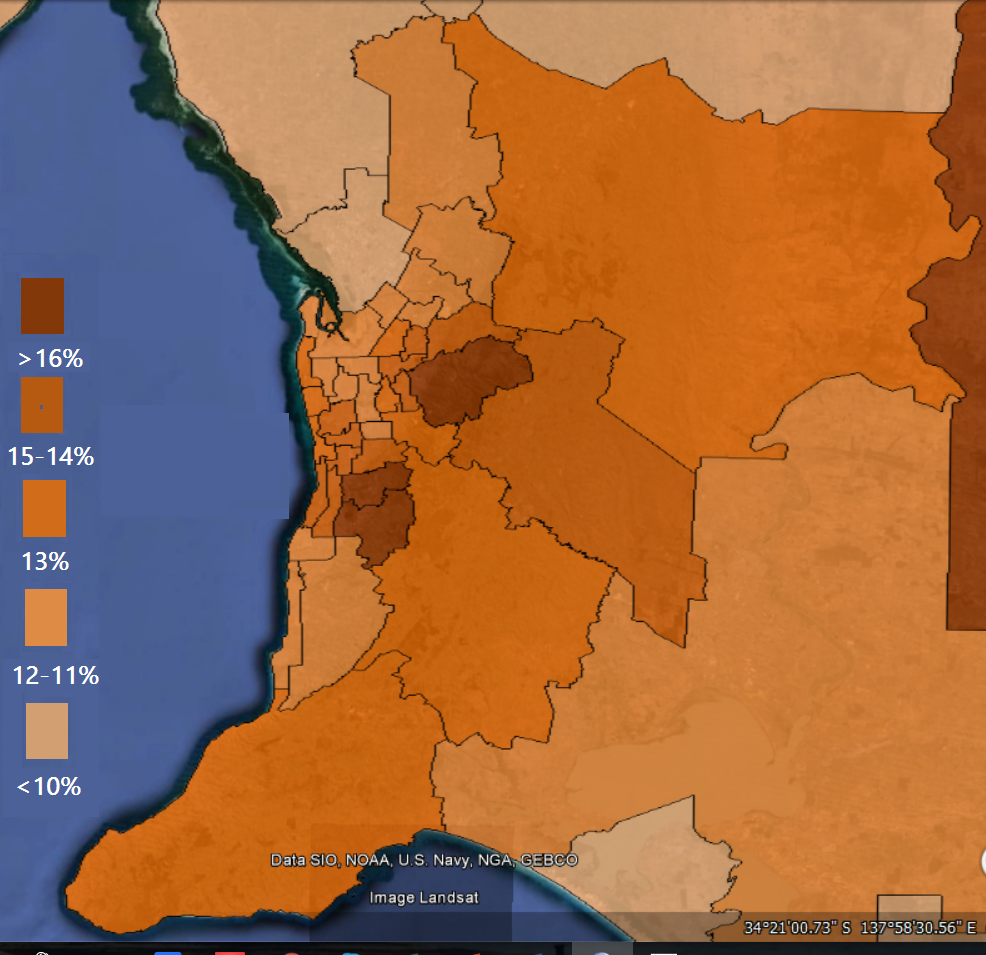
Maps thanks to Ben Raue of the Tally Room blog
The above maps show support for the Independent Nick Xenophon Team by South Australian state electorate. As you can see, the party's support is strongest in the south of Adelaide, and his support corresponds somewhat to the electoral district of Boothby. This district is held by Liberal MP Andrew Southcott, on a 7% margin.

The seats of Mayo and Sturt are also considered to be in contention for the Xenophon Team candidates. A seat poll in the electorate of Mayo in January had the Xenophon Team on 15.4%, to 17.9% for Labor and 43% for the Liberals. This is one of the few relevant (i.e. post-Abbott) seat polls that I have seen.

The key issue for Xenophon is the order in which they finish. In Sturt and Mayo, the Liberals are almost certain to finish in first place. If Labor finishes second, some of the Xenophon preferences are likely to flow to the Liberals ahead of Labor, while Labor preferences are likely to flow more strongly to Xenophon. This means that a high Labor vote could actually benefit the Liberals, and, accordingly, my advice to Liberals in Sturt and Mayo is to vote Labor. A strong Shorten campaign federally is therefore good news for (those particular) Liberals.

It is unclear whether, even if he wins seats, Xenophon will be able to hold his party together. Australian political parties heavily based around a personality, like One Nation and the Palmer United Party, have had trouble with defections. Xenophon himself has had vetting troubles; his running mate for the 2006 South Australian election, Ann Bressington, angrily attacked him soon after being elected. Whether he has learned anything from this episode is unclear; however, the odds are against the Xenophon Team being as disciplined a party as the major parties.

Tuesday, February 23, 2016

Senate Reform-Do compulsory preferences below the line matter?

Those who follow Australian politics closely will be aware that the government is introducing a bill to change the electoral system for the Australian Senate. At the moment, the Senate is elected using the single transferable vote in six-member statewide districts. Elections are staggered so that states elect twelve senators. The territories elect two senators only.

At the moment, compulsory preferential voting is used for both the Senate and the House. This means that voters are required to number every box on the ballot paper. This is not such an onerous task for the House; however, in the Senate, larger numbers of candidates run. Up until 1983, voters were required to express a preference for every candidate on the Senate ballot paper by numbering every box. This led to a high informal rate, as candidate numbers increased.

Following the election of the Hawke Labor government in 1982, the new government, motivated partially by political concerns about informal voting's impact on immigrant voters (who often voted Labor), introduced a new system. Compulsory preferencing was retained; however, before the election, parties could submit a ranked list of all the candidates on the ballot paper. Voters would put a 1 in the box above the line marked with that party's name in order to adopt that party's ticket as their vote.

A Senate ballot paper (Source:Australian Electoral Commission)
This system had the desired effect; the informal rate dropped significantly. However, it had other, less positive side effects.

It meant that parties could transfer their preferences to whichever parties they liked. For example, in 2004, the Labor Party did a deal with the Family First Party, a conservative Christian group, to swap preferences. Labor expected the deal to result in Family First preferences coming to them; instead, it resulted in Family First, on 1.9% of the primary vote, beating the Greens (on 8.8% of the primary vote) to a seat.

It has also meant that small parties can preference each other ahead of major parties, often regardless of ideology. This has meant that senators have been elected on tiny shares of the primary vote; for example, Senator Ricky Muir of the Motoring Enthusiast Party was elected to a Senate seat in Victoria off 0.5% of the primary vote by gathering preferences from a wide variety of parties. Kevin Bonham provides a more complete discussion of the issues.

In recent days, the government has introduced legislation to change the Senate electoral system. The proposed changes would introduce optional preferences above the line. Voters will only have to number one box above the line (although the ballot paper will instruct voters to number six boxes above the line). This vote will go to the candidates of that party's ballot group, and, if no further preferences are expressed, the ballot paper will exhaust (be removed from the count).

However, rather curiously, this provision will only apply above the line. People who wish to vote below the line will still have to number every box, though an extra two errors will apparently be permitted. This goes against the recommendations of the Joint Standing Committee on Electoral Matters.

Exactly who insisted on this is unclear. The legislation is being supported by the Liberal/National Coalition and the Greens, and both blame each other for the proposition. The motivation behind the decision seems to be fear that with optional preferencing, voters will change the orders of party tickets.

However, in my view, this is a baseless concern. Optional below-the-line preferencing, even if above-the-line voting is totally removed, has little impact on the specific people elected.

In New South Wales, the same electoral system as recommended by the committee is used. Voters can vote for one group above the line, which counts as preferences for that group only. They can also number fifteen or more boxes below the line. At the last state election, 1.62% of voters who voted for groups with a box above the line voted below the line. At no point in the history of this particular system have these below-the-line preferences changed the order of election.

You may ask whether the difficulty of numbering fifteen boxes against numbering one means that voters will automatically opt for the easy option. However, this does not appear to be the reason. Before the introduction of group tickets in 1988, New South Wales required voters to number fifteen candidates or more; there was no option for above the line voting. While parties put the candidates in order, it would have been no harder for people to vote against the party ticket.

So, what happened? Well, according to Antony Green's paper on these elections, at each election about 98% of voters voted for the number 1 candidate in each ballot group, and about 98% of those votes transferred to the second candidate.  In South Australia, a similar system was used. I am unsure whether voters were required to number a certain number of candidates. Once again, 98% of voters voted for the first candidate.

The issue appears to be that Australian federal elections do not provide an opportunity for individual candidates to campaign for their own support, and Senate candidates of major parties are not scrutinised. For example, Joe Bullock, a right-wing Western Australian Labor senator, was forced to run for election again following the invalidation of the previous result. Bullock's conservative views received more attention during the by-election, and, as a result, incumbent left-wing Senator Louise Pratt outpolled him on below-the-line votes.

In my view, it is foolish of the government to keep compulsory preferences below the line. If vote exhaustion is okay above the line, it is surely okay below. The political advantages of restricting below-the-line voting are irrelevant, and it would take a number of other reforms (decoupling House and Senate elections, abolition of above-the-line voting, rotating ballot positions, banning how-to-vote cards). However, for the same reason, it does not deserve so much attention; party ordering would likely remain the way Senators were chosen regardless of whether preferences were compulsory or optional.

Note-The government has abandoned the requirement to number all the boxes below the line. Voters are only required to number six boxes, though the ballot paper will state that twelve are required.