Showing posts with label Australia. Show all posts

Wednesday, November 30, 2016

Do South Australian voters get a Rau deal from the 'Voter Choice' Bill?

On 16 November this year, South Australian Attorney General John Rau introduced a bill into the House of Assembly (the lower house of South Australia's bicameral Parliament) to change the electoral system used to elect members of the Legislative Council. At present, members of the 22-member Legislative Council are elected eleven at a time for eight year terms; half face election at each election for the House of Assembly, the members of which serve four-year terms.

These elections use the single transferable vote system in one statewide district. However, the system has an important modification. Voters can either vote for one party ticket, which accepts an ordering of all the candidates in the election determined by that party and lodged with the Electoral Commission ahead of the election, or number every candidate in order of their preference. I have written about the severe flaws of this system in the past when used at the federal level, and many of the same criticisms apply to the South Australian system.

What the proposal means

If the bill is passed, South Australian voters will be faced with the same ballot paper (reproduced below) that they have received at past elections. However, the law changes substantially the functions of the above-the-line box.
20140102 SG IMG AboveLine
South Australian Legislative Council sample ballot paper (Source: Government of South Australia 2011)
Under the current system, a vote like the one on the sample paper above would have been considered an adoption of the ranking of all the candidates that was submitted to the Electoral Commission before the election. Group C might have asked that an ATL vote for them next go to the candidates of Group A, then Group D, then B and E.

The new system changes the meaning of this vote. Now it only goes to the candidates of Group C. If all the candidates of Group C are excluded, the vote then exhausts. More importantly, voters may only cast one first preference above the line. So even if the voter voted 1 for Group C and 2 for Group A, the vote would only go to the candidates of Group C, and then exhaust. If a voter wishes to express preferences across party lines, they must vote below the line; the law creates a savings provision so that a first preference for the first candidate within a party group counts as an above-the-line vote for that party.

How would this work in practice? Well, the STV system initially allocates seats to candidates who receive a Droop quota ((votes/seats+1)+1). Once no candidate has a Droop quota, the candidate with the lowest number of votes is excluded, and their preferences. However, given that most South Australians vote above-the-line (96% at the last election), and that all above-the-line votes will immediately exhaust when their party does, this will mean that the exclusions will have a very minor impact, and it is most likely that the candidates which have the highest vote share after the process of allocating seats to candidates with Droop quotas will fill those final seats.

In effect, this means that the electoral system will be very much similar to the 'largest-remainder' method of party-list proportional representation. Each elected candidate within a party will receive exactly a quota of that party's vote before being elected, and the last candidate will receive the rest of that party's vote (the remainder).

How would it work?

It's worth noting that the largest-remainder system is designed to produce a generally proportional outcome, so the Legislative Council will likely continue to have a more proportional composition than the House of Assembly, which is elected in single-member districts using the single transferable vote. This means that the chamber can still fulfil its role as a check upon the powers of the Assembly; it may reject legislation, but cannot remove the government.

Nonetheless, the system will switch emphasis from attracting preferences to entirely attracting first preference votes. It would also cause a small change in the composition of the current Legislative Council, as can be seen below.

Party
Elected in 2010
Elected in 2014
Total
Change from GTV
Labor
4
4
8
0
Liberal
5
4
9
+1
Nick Xenophon Team
0
2
2
+1
Greens
1
1
2
0
Family First
1
0
1
-1
Dignity for Disability
0
0
0
-1
The Dignity for Disability Party won their seat in 2010 off preferences from other small parties, their first preference vote being only 1.2%. The new system would have given that seat to the Liberal Party. Family First won a seat off 4.3% of the primary vote and preferences from other parties; the new system would make that 0.52 quotas, to 1.55 for the Xenophon Team. It is possible that the new system could increase the number of below-the-line votes and make preferences a factor, hence giving that seat to Family First.

Michael Gallagher's 1992 paper on the subject of different methods of party-list proportional representation discusses effective thresholds for winning seats under these methods. He concludes that the threshold of exclusion; that is to say, the minimum number of votes a party can receive without securing a seat (adding one to this total will guarantee that party a seat) for the Droop quota and largest remainder system is 1/(s+1), where s is the number of seats to be allocated (this is in percentage terms). For South Australian elections, that would be equal to 8.33% of the vote. 

Distinct from this is the threshold of representation; that is to say, the smallest number of votes a party can receive and still receive a seat. For this particular figure, the equation is 2/(p(s+1)), where s is seats, and p is the number of competing parties. At the last election, this would be equal to 0.64% of the vote. A more general threshold equation, 75%/(s+1), gives a figure of 6.25%. 

Wasted votes

One advantage of the current STV system is that nearly all votes do go to an elected candidate. Given that a candidate must receive one quota to be elected, and the quota is (votes/(seats+1)+1), only enough candidates to fill all the seats may receive quotas; hence, the maximum number of votes that do not end up with an elected candidate cannot be more than votes/(seats+1) (8.33%).

The new system, however, would be more likely to disregard a larger number of votes. If we consider a vote that is not part of a quota or a remainder rewarded with a seat 'wasted', for my analysis of the last state election, 16.4% of all votes would be wasted, compared to the 8.3% of the vote left with candidates not elected in the actual election. These figures are relatively consistent for recent elections.
Nonetheless, it is worth noting that, to some extent, the current system lowers this figure to an unrealistic amount if voter preferences are to be legitimately consulted. If group voting tickets are to be done away with, getting this figure of only a quota wasted would require voters to cast a preference for every candidate or party group. This would lead to a high informal rate; when voters were required to preference every candidate for the federal Senate, informal rates larger than 10% were not uncommon. Usage of the federal Senate system, which has optional above-the-line preferences and potentially allows votes to exhaust, would increase this figure.

Labor's hypocrisy on exhausted votes

The South Australian Labor government's willingness to tolerate high exhaustion rates contrasts interestingly with Federal Labor's conduct during the debate over introducing optional preferential above-the-line voting. Labor opposed the changes, which passed nonetheless with support from the Greens and Nick Xenophon, on several grounds. One of them was the claim, made by South Australian Senator Penny Wong, that "It (the reform) will mean the votes of up to three million voters effectively going in the bin" and "disenfranchises more than three million voters—people who, at the last election, chose to vote for someone other than the major parties or the Greens". 

Ignoring, of course, what a load of nonsense these predictions were proven to be, I find it quite remarkable that the party that found it so undemocratic that above-the-line votes could exhaust is now introducing a system that guarantees above-the-line votes will exhaust.

 Why the state Labor government is not simply copying the federal system is somewhat confusing, and introducing preferences would improve on this proposal substantially. Nonetheless, the proposal does give voters certainty that their votes will count for their explicit choices only, and the value of preferences under GTV are very much questionable if preferences do not flow the way a voter wishes.

As always, Kevin Bonham has an excellent take on the matter, if you wish to read further.

Saturday, July 30, 2016

Australian election, 2016-Xenophon, Hanson and Singh

Australia held a federal election on July 2 of this year for all members of the Federal Parliament. The Australian Federal Parliament consists of a 150-member House of Representatives and a 76-member Senate. The government is responsible to the House of Representatives, which is elected through preferential voting in single-member districts for a three year term (though it may be dissolved at any time by the Governor-General, acting on the advice of the Prime Minister).

However, all legislation must pass through the Senate, which is elected through the single transferable vote, though with substantial modifications described at the end of the article. Elections to the Senate are usually for 40 seats at a time (six Senators per state for six-year terms, plus four Territory senators elected for three-year terms), but if the Senate rejects a bill passed by the House of Representatives twice, the Prime Minister may advise the Governor-General to call an election for all members of both houses.

The result was the narrow return of the incumbent Liberal/National coalition government, led by Prime Minister Malcolm Turnbull. In the 150-member House of Representatives, the party will definitely have 76 seats, which is a majority of one. If the Speaker of the House is a Liberal, which seems likely, the government will have a majority of 75-74.

The seat of Herbert, in the north of Queensland, is the only seat that could still likely switch between the two parties. Labor candidate Cathy O'Toole narrowly edged out Liberal incumbent Ewen Jones by eight votes on initial counting; the margin increased to 35 following a recount. While a narrow margin of this sort could theoretically be upheld, any minor error in counting or voting that would be ignored in a seat with a wider margin could lead to the election heading to the courts.

Even if Herbert is won by the government, the 77 votes in the House will represent a knife-edge majority almost as close as that won by Robert Menzies in 1961 (62 Liberal/Country, 60 Labor with full voting rights). The Turnbull government will have the advantage, though, that the Labor Party do not have all the remaining MPs. The House of Representatives crossbench consists of one Green, one Katter's Australian Party (Bob himself), two Independents (Andrew Wilkie in Denison and Cathy McGowan in Indi) and one member of the Nick Xenophon Team.

Whether these members will support the government consistently is unclear. The AEC conducts preference counts between the two major nationwide parties in each seat for statistical purposes. At the last election, McGowan's division of Indi split 59-41 to the Liberals, and Katter's division of Kennedy went 67-33. The Xenophon Team's seat of Mayo split 63-37 to the Liberals, though the Xenophon Team's preferences are more of an unknown quantity. Consistent opposition to the government, or supporting the installation of a Labor government, would likely be harmful to the future electoral prospects of these MPs.

The Xenophon Team's result

Before this election, I wrote about the Xenophon Team's prospects. I said that the difficulty Xenophon had in transferring his support to his chosen candidates, demonstrated in the 2014 South Australian election, would make a Xenophon lower house seat unlikely. Nonetheless, the party appears to have won a seat. So, how big was the difference between Xenophon Team House candidates and the support for the man himself?

Measuring the dropoff between Xenophon's House and Senate support simply by comparing their share of the votes in both houses is the obvious way to do this; however, it is something of an unfair comparison, given that there were an average of 6.5 candidates per House seat compared to 23 groups in the Senate. Nonetheless, here it is, though this is based on somewhat incomplete vote totals (as counting and data entry still continues).


In only three seats (Mayo, Barker and Grey) did the Xenophon House candidate outperform the Senate ticket, even with increased choice on the Senate ballot paper. Incidentally, these three seats were the strongest for Xenophon Team House support. On average, the Xenophon Team performed 1.24% stronger in the Senate than the House. This suggests that the dropoff between Xenophon House and Senate support is smaller than the 2014 SA election would suggest, but still substantial.

Incidentally, if you calculate Xenophon Team support as a percentage of the total for the parties that contested all the House seats (that is; Labor, the Greens, NXT, the Liberals, and Family First) in both houses, you get a somewhat different result.

This result moves Grey into the seats where the NXT Senate ticket performed better than the House, and increases the average to 2.3%. In general, NXT did not make much of an impact in the other states, winning an average of 1.8%, and probably not enough to win a seat (though a very strong performance on preferences might give them a chance in Western Australia). However, they won 21.6% in SA, giving them 2.8 quotas and likely three seats.

One Nation, under Palmer?

The other substantial new minor party presence in this election was the One Nation party. This party was formed by Pauline Hanson, elected as an independent in the seat of Oxley in 1996 (with a nearly 20% swing towards her) after being disendorsed by the Liberal Party for making controversial comments about indigenous Australians. One year later, she formed a political party, called One Nation. This party espoused anti-immigration views, though, as is not uncommon with this sort of party, supported somewhat economically leftist policies, especially opposition to privatisation and free trade (a lot of her views are laid out in her maiden speech to the House).

This party first contested the 1998 Queensland election, winning eleven seats and 22.7% of the vote. However, the party soon split into two, with some MPs joining the City Country Alliance (warning: vile web design), and the party lost most of its seats at the 2001 election. 

At the federal election of 1998, the party won 8.4% of the House vote (14.3% in Queensland) and 9% of the Senate vote, though weak preference flows meant that this only translated into one seat, in Queensland. Hanson ran in the seat of Blair, and won 36% of the primary vote to 25.3% for Labor, 21.7% for the Liberals, and 10.2% for the Nationals; however, the Liberal candidate received enough preferences from the National to pull ahead of the Labor candidate, whose preferences elected the Liberal over Hanson 53-47.

This election represented a peak for One Nation, whose vote roughly halved at the next election, and declined to below 1% after that. Hanson continued to contest elections, though often not as a member of the One Nation party; she ran as a member of her own United Australia Party for the Senate in 2007, winning 4.2%. She came close to winning a seat in the New South Wales upper house in 2011, ran for the Senate in 2013 (and would have potentially won had voters not confused the Liberal Party with David Leyonhjelm's Liberal Democrats), and came within 0.2% of winning the Queensland state electorate of Lockyer in 2015).

But now, she appears to have certainly returned to the Senate, as One Nation has secured 9.1% of the Senate vote in Queensland, comfortably above the quota for election to one of the twelve seats. One Nation are also in contention to win a seat in New South Wales and Western Australia with about 4%. They also missed out on a Tasmanian Senate seat by 140 votes off 2.57% of the primary vote.

So, where does this One Nation vote come from? Well, the below chart shows how the One Nation vote correlates to the vote of the party whose vote dropped most dramatically at this election: the Palmer United Party. This party was formed by mining billionaire Clive Palmer leading up to the 2013 election, and won two Senate seats (with an extra member elected in the Western Australia re-election) and one House seat (Palmer himself won the seat of Fairfax). However, two of the party's Senators left, and Palmer did not recontest Fairfax. None of the party's Senate tickets secured as much as half a percent of the vote.

The below chart shows the correlation between the Senate vote for the Palmer United Party in 2013, and the Senate vote for One Nation (based off current counting) for this year.

The two variables have a correlation coefficient of 0.73, suggesting a relatively close correlation. However, this likely reflects the fact that in most electorates, both One Nation and the Palmer United Party are/were a relatively minor presence. In inner-city electorates, both One Nation and the Palmer United Party having roughly 1% of the vote is not an especially meaningful correlation. The below chart shows the correlation for the divisions where the Palmer United Party received more than 7% of the Senate vote (the vast majority of which are in Queensland).
Here, we see much greater variation, and a much weaker correlation coefficient of 0.22. While this is dragged down somewhat by the presence of Jacquie Lambie in Tasmania (presumably taking some of One Nation's constituency), there are only two Tasmanian electorates in that dataset. While both the Palmer United Party and One Nation have substantial support in Queensland, they do appear to have substantial differences in where they win support there.

Lisa Singh wins on BTL votes-could it happen elsewhere?

So far, only two jurisdictions have declared Senate results; Tasmania, and the Northern Territory. The Senate electoral system has changed this year. Amongst other changes, voters now only have to number six boxes in order to cast a formal vote below the line (for individual candidates), though the ballot paper says twelve.

When tickets for the Senate were drawn up for Tasmania, two controversial decisions were made. Labour incumbent Senator Lisa Singh was demoted to fifth on the ticket, a very difficult position to win, while Liberal Tourism Minister Richard Colbeck was moved to the same placing. 

As casting a vote for these candidates individually is much easier under the new system, both Colbeck and Singh either ran, or had campaigns run for them, to encourage people to vote for them below the line. In the end, Singh was returned to the Senate, with 6.12% of the below-the-line vote, while Colbeck was not returned, despite winning 4% of below-the-line votes. The result represents the first time since the 1950s, and the first time since any type of above-the-line voting existed, that a Senator has been elected out of party ordering.

So, could the new system allow this to happen in other parts of the country? My answer is probably not. As I wrote when I was discussing the initial version of Senate reform, that would have required voters to number every box below the line, the states of South Australia and New South Wales both fairly briefly used the single transferable vote for multiple seats to elect their upper houses, without any form of above-the-line voting. While New South Wales required voters to number seventeen boxes, while all were required in South Australia, the systems shared one common characteristic; it was no harder to vote against the party ticket than to fully accept it. In both of these cases, the vast majority of voters appear to have accepted the party ticket.

The fact is that Tasmania is a much smaller state than any on the mainland, and running a statewide campaign for below-the-line votes is therefore much less costly than in any of the mainland states. Given that political parties have expressed an unwillingness to encourage such campaigning, doing it on a larger scale would prove difficult. Colbeck and Singh had the wind to their backs in another way; this election is a double dissolution, for twelve Senators, while most Senate elections would be for six, making it even harder to win a seat.

Though the equal distribution of votes between a party's candidates is often advantageous (if too many votes are concentrated on one of a party's candidates, it can lead to the other candidates of that party being excluded early, thus costing that party seats), Australian political parties appear to remain opposed to individual campaigns. The difficulty a Senate candidate's campaign would face in getting attention in the midst of a House election, with the Prime Ministership at stake, would add to these difficulties. Outside of Tasmania, it will be unlikely for any Senate candidates to be elected outside their party's ranking in the near future.

Tuesday, April 19, 2016

Prospects for the Nick Xenophon Team

Senator Nick Xenophon is one of Australia's best-known politicians who is not a member of the two major parties. He was an independent member of the South Australian Legislative Council from 1997 to 2007, and a federal Senator from then up until now.

His political career started when he ran for the South Australian Legislative Council in 1997 as an Independent No Pokies (anti-poker machine) candidate. Under South Australian electoral law, independent candidates are allowed a box above the line, with a four-word description after the word 'independent'.

South Australia's Legislative Council is elected using the single transferable vote. However, it has one key modification. Voters can either write the number 1 in the box above the line, which accepts the preference ticket of the party, or they can number every box for every candidate below the line. This system is used in Western Australia for their upper house, and with some modifications in Victoria (voters are not required to number every box below the line). It was used in the federal Senate until recently, when the Turnbull government repealed it.

This system means that parties can direct strong preference flows, allowing little-known candidates to win with small shares of the first preference vote. Xenophon's ticket received 2.86% of the first preference vote; 0.34 of a quota. However, he received ticket preferences from seven other minor parties, allowing him to be elected comfortably.

As neither the state Labor government nor the Liberal opposition had a majority in the Legislative Council, and as Legislative Council assent is required for all legislation, Xenophon was put in a fairly powerful position. He attached himself to a variety of populist causes, such as cutting entitlements for politicians and consumer rights issues.

He also uses irritatingly punny publicity stunts subtle visual metaphor to attract attention to himself, such as putting a large fake box of powdered gravy crystals on a model train (get it?), leading a goat through central Adelaide (the joke being that Xenophon was advising people not to kid around from their vote), leading a donkey through central Adelaide (to demonstrate that he would work like a mule for South Australia, and that he was willing to make an ass of himself to get elected), and announced his run for the Senate in 2007 outside the giraffe enclosure (he's sticking his neck out for South Australia). So far as I know, he has not posed near any giant archery equipment.

In 2006, he was re-elected to the South Australian Legislative Council. His ticket received 20.5% of the first preference vote, only 6% behind the state Liberals, allowing an extra member of his party to be elected. This candidate was Ann Bressington, who left the party just one year after the election (perhaps a demonstration of Xenophon's vetting ability?).

Following this, and with an appropriate pun discussed above, Xenophon announced a run for Federal Parliament. While he could perhaps have won a seat in the House of Representatives, that would give him little influence over legislation. He ran for a Senate seat, as an independent, and received 14.78% of the primary vote. This comfortably gave him a seat.

Xenophon was in a very politically important position at this point. The 2007 election had seen the election of a Labor Party government under the leadership of Kevin Rudd. However, Labor's weak performance at the previous election meant that the government only had 32 seats in the 76 member Senate, to 37 for the Liberal/National opposition. The Greens had five senators, and the remaining seat was held by the Family First party. With 39 votes needed to pass legislation, Xenophon was placed in a fairly powerful position; Labor needed total crossbench support to pass legislation.

This meant that Xenophon was able to extract concessions on certain issues. For example, when the Rudd government needed to pass a stimulus package in 2009, Xenophon threatened to block it unless $900 million in funding for water projects (mostly in South Australia).

Xenophon was not up for election in 2010, and he did not run a ticket. However, the election substantially weakened his power. In the Representatives, the Labor Party won 72 seats, and formed a coalition with a number of independent MPs to win 76 seats (a narrow majority). In the Senate, however, the Labor Party won 31 seats and the Greens won 9, giving both parties together a majority. As they were in coalition in the House, the 'government' had a Senate majority, and there was no need to negotiate with Xenophon.

Despite this, Xenophon was easily re-elected in 2013. He received 24.88% of the vote, was elected himself, and only missed out on a second seat because Labor, Green and assorted minor party preferences flowed against his second candidate.

The results of that election led to a Liberal-National government taking power federally. This swing meant that the Labor and Green parties lost control of the Senate, with the Labor Party winning 25 seats and the Greens 10. The Liberal Party won 33 seats, which meant that they would need the support of six of the crossbenchers, which included three members of the Palmer United Party, and one member each of the Liberal Democratic Party, Family First Party, Democratic Labour Party, and Motoring Enthusiast Party.

The Palmer United Party, a vanity party by Queensland mining millionaire, had the balance of power until Tasmanian Senator Jacquie Lambie and Queensland Senator Glenn Lazarus left the party. This meant that Xenophon shared the balance of power with the other senators, and the government was forced to negotiate with him.

The term of the House of Representatives is scheduled to expire this year, thus meaning what would normally be an election for the whole House and half of the Senate. However, under the Australian Constitution, if the Senate rejects a bill passed by the House of Representatives two times, the government is able to call an election for the whole Senate and House. Hoping to remove some of the crossbenchers elected on small primary votes after the recent reform of the Senate electoral system, the government now appears to have secured a trigger for a double dissolution, following the failure of the Senate to pass bills regarding industrial relations.

Xenophon, meanwhile, has been busy forming a new political party. In July, he registered the 'Nick Xenophon Group' as a political party, which he only used to run for election in South Australia. However, he has recently renamed it to the 'Nick Xenophon Team', and also announced that he will run Senate candidates in every state and House candidates in selected electorates.

How will this party do?

It is no secret that Nick Xenophon is very popular in South Australia. However, what is also noticeable is that there is a substantial gap between support for him and support for a ballot group with his name on it.

At the 2014 South Australian state election, the candidate who had been Xenophon's running mate (third position on the ticket, appointed to the Legislative Council), John Darley, was up for election. Darley ran as the 'Independent Nick Xenophon Team' candidate, which was his ballot description. The ticket received 12.9%, a halving of the vote from the 2013 federal election.

This is why a double dissolution is an advantage for Xenophon. Evidently, there is a dropoff in the Xenophon Team vote when Xenophon is not on the ballot paper. A double dissolution can allow Xenophon to avoid the Senate election when he is not personally on the ballot paper.

The exact effects of the dropoff are not entirely clear. However, as Xenophon is not running for the lower house, we will be able to see the exact effects of it in this election. I think it will be large enough to rule out a NXT candidate winning a lower house seat.


Maps thanks to Ben Raue of the Tally Room blog
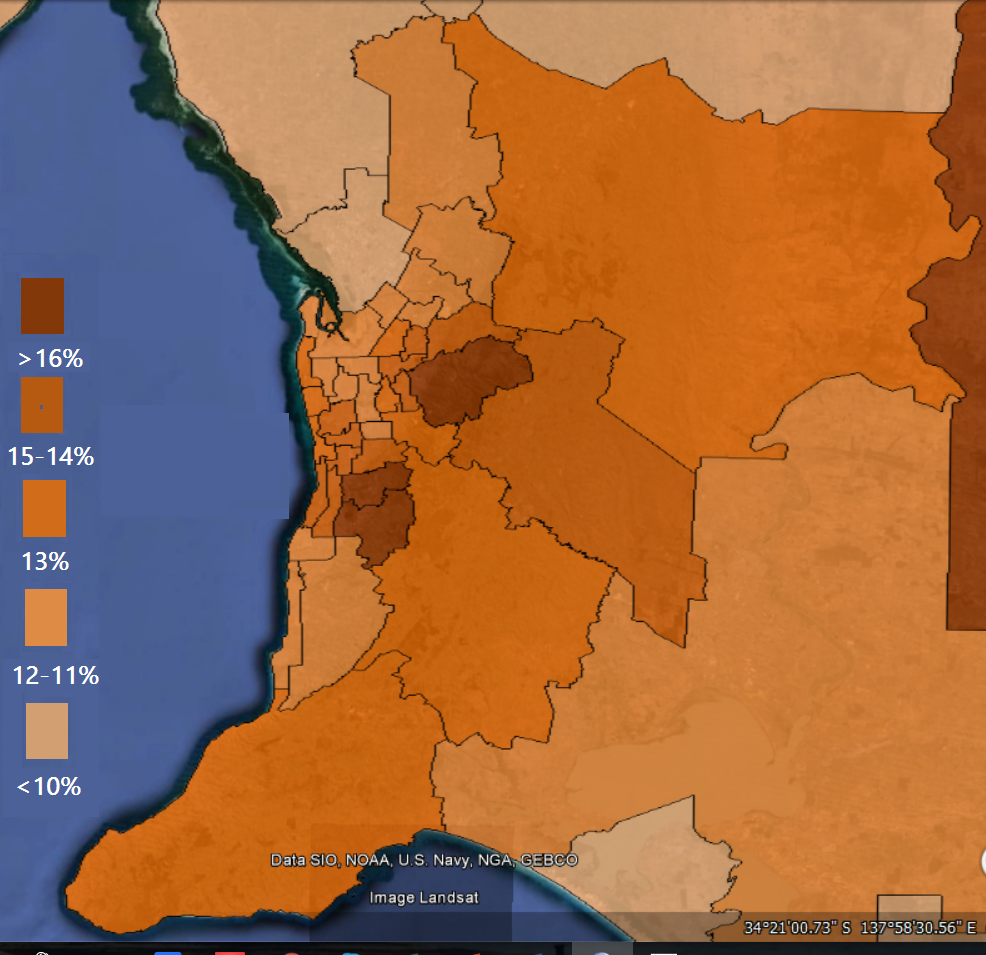
The above maps show support for the Independent Nick Xenophon Team by South Australian state electorate. As you can see, the party's support is strongest in the south of Adelaide, and his support corresponds somewhat to the electoral district of Boothby. This district is held by Liberal MP Andrew Southcott, on a 7% margin.

The seats of Mayo and Sturt are also considered to be in contention for the Xenophon Team candidates. A seat poll in the electorate of Mayo in January had the Xenophon Team on 15.4%, to 17.9% for Labor and 43% for the Liberals. This is one of the few relevant (i.e. post-Abbott) seat polls that I have seen.

The key issue for Xenophon is the order in which they finish. In Sturt and Mayo, the Liberals are almost certain to finish in first place. If Labor finishes second, some of the Xenophon preferences are likely to flow to the Liberals ahead of Labor, while Labor preferences are likely to flow more strongly to Xenophon. This means that a high Labor vote could actually benefit the Liberals, and, accordingly, my advice to Liberals in Sturt and Mayo is to vote Labor. A strong Shorten campaign federally is therefore good news for (those particular) Liberals.

It is unclear whether, even if he wins seats, Xenophon will be able to hold his party together. Australian political parties heavily based around a personality, like One Nation and the Palmer United Party, have had trouble with defections. Xenophon himself has had vetting troubles; his running mate for the 2006 South Australian election, Ann Bressington, angrily attacked him soon after being elected. Whether he has learned anything from this episode is unclear; however, the odds are against the Xenophon Team being as disciplined a party as the major parties.

Tuesday, February 23, 2016

Senate Reform-Do compulsory preferences below the line matter?

Those who follow Australian politics closely will be aware that the government is introducing a bill to change the electoral system for the Australian Senate. At the moment, the Senate is elected using the single transferable vote in six-member statewide districts. Elections are staggered so that states elect twelve senators. The territories elect two senators only.

At the moment, compulsory preferential voting is used for both the Senate and the House. This means that voters are required to number every box on the ballot paper. This is not such an onerous task for the House; however, in the Senate, larger numbers of candidates run. Up until 1983, voters were required to express a preference for every candidate on the Senate ballot paper by numbering every box. This led to a high informal rate, as candidate numbers increased.

Following the election of the Hawke Labor government in 1982, the new government, motivated partially by political concerns about informal voting's impact on immigrant voters (who often voted Labor), introduced a new system. Compulsory preferencing was retained; however, before the election, parties could submit a ranked list of all the candidates on the ballot paper. Voters would put a 1 in the box above the line marked with that party's name in order to adopt that party's ticket as their vote.

A Senate ballot paper (Source:Australian Electoral Commission)
This system had the desired effect; the informal rate dropped significantly. However, it had other, less positive side effects.

It meant that parties could transfer their preferences to whichever parties they liked. For example, in 2004, the Labor Party did a deal with the Family First Party, a conservative Christian group, to swap preferences. Labor expected the deal to result in Family First preferences coming to them; instead, it resulted in Family First, on 1.9% of the primary vote, beating the Greens (on 8.8% of the primary vote) to a seat.

It has also meant that small parties can preference each other ahead of major parties, often regardless of ideology. This has meant that senators have been elected on tiny shares of the primary vote; for example, Senator Ricky Muir of the Motoring Enthusiast Party was elected to a Senate seat in Victoria off 0.5% of the primary vote by gathering preferences from a wide variety of parties. Kevin Bonham provides a more complete discussion of the issues.

In recent days, the government has introduced legislation to change the Senate electoral system. The proposed changes would introduce optional preferences above the line. Voters will only have to number one box above the line (although the ballot paper will instruct voters to number six boxes above the line). This vote will go to the candidates of that party's ballot group, and, if no further preferences are expressed, the ballot paper will exhaust (be removed from the count).

However, rather curiously, this provision will only apply above the line. People who wish to vote below the line will still have to number every box, though an extra two errors will apparently be permitted. This goes against the recommendations of the Joint Standing Committee on Electoral Matters.

Exactly who insisted on this is unclear. The legislation is being supported by the Liberal/National Coalition and the Greens, and both blame each other for the proposition. The motivation behind the decision seems to be fear that with optional preferencing, voters will change the orders of party tickets.

However, in my view, this is a baseless concern. Optional below-the-line preferencing, even if above-the-line voting is totally removed, has little impact on the specific people elected.

In New South Wales, the same electoral system as recommended by the committee is used. Voters can vote for one group above the line, which counts as preferences for that group only. They can also number fifteen or more boxes below the line. At the last state election, 1.62% of voters who voted for groups with a box above the line voted below the line. At no point in the history of this particular system have these below-the-line preferences changed the order of election.

You may ask whether the difficulty of numbering fifteen boxes against numbering one means that voters will automatically opt for the easy option. However, this does not appear to be the reason. Before the introduction of group tickets in 1988, New South Wales required voters to number fifteen candidates or more; there was no option for above the line voting. While parties put the candidates in order, it would have been no harder for people to vote against the party ticket.

So, what happened? Well, according to Antony Green's paper on these elections, at each election about 98% of voters voted for the number 1 candidate in each ballot group, and about 98% of those votes transferred to the second candidate.  In South Australia, a similar system was used. I am unsure whether voters were required to number a certain number of candidates. Once again, 98% of voters voted for the first candidate.

The issue appears to be that Australian federal elections do not provide an opportunity for individual candidates to campaign for their own support, and Senate candidates of major parties are not scrutinised. For example, Joe Bullock, a right-wing Western Australian Labor senator, was forced to run for election again following the invalidation of the previous result. Bullock's conservative views received more attention during the by-election, and, as a result, incumbent left-wing Senator Louise Pratt outpolled him on below-the-line votes.

In my view, it is foolish of the government to keep compulsory preferences below the line. If vote exhaustion is okay above the line, it is surely okay below. The political advantages of restricting below-the-line voting are irrelevant, and it would take a number of other reforms (decoupling House and Senate elections, abolition of above-the-line voting, rotating ballot positions, banning how-to-vote cards). However, for the same reason, it does not deserve so much attention; party ordering would likely remain the way Senators were chosen regardless of whether preferences were compulsory or optional.

Note-The government has abandoned the requirement to number all the boxes below the line. Voters are only required to number six boxes, though the ballot paper will state that twelve are required.

Saturday, October 31, 2015

Infodump-Australian Capital Territory election, 1989

For some of my readers, this post is not going to be especially interesting. This post is mostly to put some data out there that may be useful to those seeking a record of Australian electoral history, and that is in too awkward a format to add to Wikipedia.

The Australian Capital Territory, after its formation, was directly governed by the federal government. Gough Whitlam's government established an elected assembly for the ACT, like with the Northern Territory. However, unlike the Northern Territory, the ACT was not given self-government; the assembly retained mainly an advisory role.

In 1978, a referendum took place on the governing status of the ACT. Voters were offered three options. They could vote for the ACT to have self-government, with the same power the Northern Territory has. This would effectively remove the role for the Federal Government in the government of the ACT. They could vote for power to be shared between an elected local government body and the federal government. Or, they could vote for the status quo.

The result was a landslide for the status quo. Territorians did not like the idea of more politicians, and did not want to have the same funding arrangements as the states. The government respected the result, and the current arrangements were kept in place. The elected advisory Assembly was continued, but voter interest was low.

In 1988, however, the federal Labor government decided to introduce self-government unilaterally. Four pieces of legislation were passed by the Federal Parliament to introduce self-government. The government would be a minimalist one; there would be no representative of the Crown to give assent to legislation, dissolve the legislature or appoint a cabinet. Assent to legislation would be automatically given by passage through the legislature, legislatures would have fixed terms, and the Chief Minister would be elected by secret ballot in the legislature and would then appoint a cabinet.

One of the most controversial parts of the legislation was the electoral system for the legislature. The Labor Party wanted the same electoral system as used for the federal House of Representatives; preferential voting with single member districts. However, Labor did not have a majority in the Senate at the time, and needed Liberal/National or Australian Democrat support for the legislation. 

Both parties, fearing that the ACT's homogeneous electoral geography would lead to Labor domination over the territory's government, blocked the legislation and demanded that the government introduce a proportional system. Labor, seeing this as inevitable, decided to go with a party-list system. The Australian Democrats didn't like this, though. Their status as a centrist party meant that they would be advantaged by preferential voting, and so they supported a system that would include preferences in a similar way to the single transferable vote. The Senate process merged the two systems, in a way that made a mess of both of them.

"Modified D'Hondt"

The resulting system was christened 'Modified D'Hondt'. It combined many of the key elements of the system used for the Senate, as well as party list proportional representation. These two have been combined before in Australia; South Australia used a hybrid of the two for elections to their upper house in the 1970s. Voters were permitted to number as many or as few parties as they wanted. Parties that failed to receive one-half of the Droop quota (about 4.16% of the vote) had their preferences distributed to parties that had hit that threshold. All seats were then distributed using the largest-remainder system and the Droop quota. However, the ACT system added a few more complicated features. I'll get right into the explanation.

Voting

Voting under Modified D'Hondt was a relatively simple process. The ballot paper was similar to that used for the Senate. There was a thick black line across the paper, with boxes for parties above the line and boxes for their candidates below. Voters voted by placing the number 1 in any box. That's all. They could number boxes for as many or as few candidates or parties as they wished, and they could number both parties and candidates (for example, you could vote 1 for John Smith, a Liberal candidate, 2 for the Labor Party box, and 3 for Jane Smith, a Green candidate).

Despite this, the informal rate was similar to the last federal House of Representative elections, where more preferences are required; it was speculated that this was due to people writing disparaging comments about the candidates on the ballot paper.

Counting

Counting was a more complicated process. It happened in stages. The first stage of counting was the simplest. All votes for a party or its candidates were counted and added up. The total of this was divided by 18 (the Droop quota; votes/seats+1). Parties that did not have this many votes were excluded from the count from this point on. This aspect of the law was controversial. Thresholds are fairly common under party-list systems, but at that point had only been used in South Australia under the aforementioned list system. 

At the second stage, the preferences from the parties that had failed to meet the quota were distributed. So, if you had voted 1 Shooters 2 Liberal, and the Shooters had failed to meet the quota, your vote would now go to the Liberal Party. At this point, party and candidate votes were not distinguished between. Votes with no preferences outside a party (i.e 1 Shooters, 2 Robert Jones, who is a Shooters candidate) could be transferred according to the party voting ticket, which was a list of all the parties in ranked order. If there was preferences outside a party, but none of them were for a party that had met the quota, the vote was exhausted and set aside: it will not play any further role in the count.

At the third stage, the D'Hondt system was used to distribute seats to parties in the normal way, using vote totals determined through the preferences. These were not formal allocations, though. Under the electoral law, these were considered only 'provisional', for reasons to be explained later.

At the fourth stage, seats were provisionally allocated to candidates within parties, based on the number of seats the parties had been provisionally allocated. This was done using the single transferable vote to count the rankings voters made when they voted for parties. A vote above the line for a party counted as a vote down that party's ticket. An incomplete vote within a ticket would have its preferences counted as far as they had been expressed. Further preferences in that vote would be considered ticket votes. For this reason, few candidates were elected outside their party's order.

At the fifth stage, candidates who had not been provisionally elected, but who were part of parties who had won a quota, had their preferences distributed to the next candidate still in the count. Candidates were not 'excluded' per se; they could still have votes distributed back to them.

The sixth stage was effectively a repetition of the third. The D'Hondt system was used to distribute seats amongst the parties using the new, adjusted vote totals. It would be possible that the seat distribution would change at this stage. As could be expected, the seventh stage was a repetition of the fourth. The single transferable vote was used to distribute seats within parties, using the new votes. These seats were final.

Election results

The results below are votes for individual candidates, organised into parties. Please note that first preference votes cast for more than one candidate within a party have been counted as party votes. An asterisk (*) denotes elected candidates.
Party/Candidate
Votes %
Labor 24587 17.33%
Rosemary Follett* 6654 4.69%
Paul Whalan* 321 0.23%
Wayne Berry* 90 0.06%
Ellnor Grassby* 90 0.08%
Bill Wood* 159 0.11%
Di Ford 33 0.02%
Kevin Gill 96 0.07%
Anna Robieson 40 0.03%
Martin Atteridge 40 0.03%
Peta Beelen 22 0.02%
Barry Reid 260 0.18%
Total Labor 32410 22.85%
Liberal 15526 10.94%
Gary Humphries* 3446 2.43%
Trevor Kaine* 1203 0.85%
Robyn Nolan* 70 0.05%
Bill Stefinak* 234 0.16%
Greg Cornwell 171 0.12%
Lyle Dunne 49 0.03%
Peter Kobold 90 0.06%
Judith Dowson 67 0.05%
Peter Jansen 86 0.06%
Bob Winnel 137 0.10%
Total Liberal 21079 14.86%
No Self Government Party 14125 14.86%
Craig Duby* 1657 1.17%
Carmel Maher* 55 0.04%
David Prowse* 54 0.04%
John Taylor 55 0.04%
Norman Henry 23 0.02%
Peter Alabaster 55 0.04%
John Cunningham 42 0.03%
Chris Elworthy 18 0.01%
Elma Lindh 14 0.01%
Nev Aurousseau 14 0.01%
John Cantlon 14 0.01%
Ken Durie 10 0.01%
Bob Smythe 31 0.02%
Lindsay Sales 11 0.01%
Phillipa Meredith 22 0.02%
Jack Wight 22 0.02%
Yvonne Hammond 44 0.03%
Total No Self Government Party 16274 11.47%
Residents Rally 8765 6.18%
Bernard Collaery* 1855 1.31%
Norm Jensen* 129 0.09%
Michael Moore* 301 0.21%
Hector Kinloch* 1696 1.20%
Joan Kellett 191 0.13%
Chris Donohue 142 0.10%
Marion Le 385 0.27%
Kevin Giles 77 0.05%
Catherine Rossiter 106 0.07%
Total Residents Rally 13647 9.62%
Abolish Self Government Coalition 9165 6.46%
Dennis Stevenson* 1327 0.94%
Flo Grant 36 0.03%
Gladys Dickson 15 0.01%
Chris Tazreiter 33 0.02%
Nerolie Bush 17 0.01%
Geoff Dopel 29 0.02%
Trish Orton 10 0.01%
Gail Aiken 20 0.01%
Mike Trevethan 35 0.02%
Reg Hayward 6 0.00%
Colin Beaton 15 0.01%
John Hesketh 23 0.02%
Total Abolish Self Government Coalition 10721 7.56%
Abolish Self Government Coalition 9165 6.46%
Dennis Stevenson* 1327 0.94%
Flo Grant 36 0.03%
Gladys Dickson 15 0.01%
Chris Tazreiter 33 0.02%
Nerolie Bush 17 0.01%
Geoff Dopel 29 0.02%
Trish Orton 10 0.01%
Gail Aiken 20 0.01%
Mike Trevethan 35 0.02%
Reg Hayward 6 0.00%
Colin Beaton 15 0.01%
John Hesketh 23 0.02%
Total Abolish Self Government Coalition 10721 7.56%
Fair Elections Coalition 1397 0.98%
Tony Fleming 5269 3.71%
Alan Runciman 494 0.35%
Sara Kirchbaum 94 0.07%
Gordon McAllister 19 0.01%
Gus Petersilka 345 0.24%
Julie McCarron-Benson 147 0.10%
Total Fair Elections Coalition 7765 5.47%
Fair Elections Coalition 1397 0.98%
Tony Fleming 5269 3.71%
Alan Runciman 494 0.35%
Sara Kirchbaum 94 0.07%
Gordon McAllister 19 0.01%
Gus Petersilka 345 0.24%
Julie McCarron-Benson 147 0.10%
Total Fair Elections Coalition 7765 5.47%
Independent Haslem 4253 3.00%
John Haslem 2548 1.80%
Caryl Haslem 66 0.05%
Total Independent Haslem 6867 4.84%
ACT Community Party 1645 1.16%
Ken Fry 3977 2.80%
Dominic Mico 142 0.10%
Lorne Doyle 13 0.01%
Total ACT Community Party 5777 4.07%
Canberra First Party 3774 2.66%
Allan Nelson 904 0.64%
Beryl Byrnes 29 0.02%
John McMahon 17 0.01%
Jeff Brown 74 0.05%
Michael Apps 18 0.01%
Barry Brogan 21 0.01%
Jennie Booth 8 0.01%
Arthur Hetherington 5 0.00%
Elizabeth Apps 16 0.01%
Mike McColl 31 0.02%
Matt Campbell 9 0.01%
Garry Behan 12 0.01%
Total Canberra First 3885 2.74%
Family Team 2929 2.06%
Bev Cains 686 0.48%
Ron Gane 26 0.02%
Bill Fearon 22 0.02%
Dennis Meagher 34 0.02%
Drewe Just 12 0.01%
Total Family Team 3885 2.74%
Australian Democrats 1720 1.21%
Arminel Ryan 515 0.36%
Bill Mason 47 0.03%
Heather Jeffcoat 68 0.05%
Total Australian Democrats 2350 1.66%
National Party 1477 1.04%
David Adams 380 0.27%
Michael Mullins 58 0.04%
Bruce MacKinnon 32 0.02%
Total National Party 1947 1.37%
Sun Ripened Warm Tomato Party 1165 0.82%
Emile Brunoro 453 0.32%
Rick Kenny 48 0.03%
Total Sun Ripened Warm Tomato 1666 1.17%
Party!Party!Party! 733 0.52%
Amanda Call 200 0.14%
Shane McMillan 46 0.03%
Total Party!Party!Party 979 0.69%
Christian Alternative Party 580 0.41%
Nathan Stirling 222 0.16%
Bernadette Ibell 44 0.03%
Total Christian Alternative Party 846 0.60%
Socialist Workers Party 483 0.34%
Kristian Whittaker 230 0.16%
Total Socialist Workers Party 713 0.50%
Sleepers Wake 120 0.08%
John Bellamy 53 0.04%
Total Sleepers Wake 173 0.12%
Surprise Party 124 0.09%
C.J.Burns 42 0.03%
Total Surprise Party 166 0.12%
Disabled and Redeployed Workers Party 106 0.07%
Peter Burrows 50 0.04%
Derek Robinson 7 0.00%
Total Disabled and Redeployed Workers Party 140 0.10%
Tony Spagnolo Independent for Canberra 75 0.05%
Tony Spagnolo 65 0.00%
Total Tony Spagnolo Independent for Canberra 140 0.10%
A Better Idea 64 0.05%
Michael Scurfield 16 0.01%
Total A Better Idea 80 0.06%
Home Rule OK 41 0.03%
Tony Boye 21 0.01%
Total Home Rule OK 62 0.04%
Independent candidates
Bill Mackey 5686 4.01%
Harold Hird 1872 1.32%
Lyall Gillespie 522 0.37%
Frank Crnkovic 445 0.31%
Bill Pye 414 0.31%
John Rocke 149 0.11%
Bob Reid 121 0.09%
Gary Pead 75 0.05%
Tony Boye 60 0.04%

Tuesday, March 17, 2015

NSW election 2015-who are the unknown ballot groups?

The New South Wales election is due to be held on the 28th of March. I haven't had much time to write recently, and for more information on this particular election, visit the ABC's guide.

As I write this post, nominations for both houses are closed. There are 540 candidates for the lower house (an average of 6 per seat) and 394 candidates in the upper house. The latter figure is a record, and it is mostly due to the rather onerous requirements for parties in the Upper House.

After the 1999 election, which used Single Transferable Voting with Group Tickets  and which resulted in both an enormous number of candidates and the election of certain candidates with extremely low shares of the primary vote, a number of reforms were introduced. For a start, party registration fees were increased, and party membership requirements were increased.

However, another big change was introduced. Above-the-line voting was retained, but under the new rules, an above-the-line vote counted only for the candidates in the group that was below it. So, if you voted for the Liberal Party 1 above the line, your vote would go 1 for the first Liberal, 2 for the second, and so on until you got to the end of the Liberals, at which point your vote would exhaust.

However, you could also use preferences above the line. So, if you voted Liberal 1 and Christian Democrats 2 above the line, when your vote got to the end of the Liberals, it would go to the number 1 candidate of the Christian Democrats, and the number 2 candidate, and so on.

Why did this system make fielding candidates harder for small parties? Well, under the NSW Constitution, a voter must cast fifteen preferences in order to cast a formal vote. As a result, in order to secure an above-the-line box, a party needs to nominate fifteen candidates, compared to only two under the previous system. This means that they need to pay $5000, a significant sum which is only returned if a candidate is elected or the group gets 4%, and get fifteen people on the ballot paper.

Anyway, this is why there are so many candidates on the ballot paper. But, there is another oddity on the NSW Legislative Council ballot paper. There are eight ballot groups with no party affiliation. Six of them have above-the-line boxes; for some reason, the other two have only two candidates, and voters for them will be required to vote below the line (voters below the line only have to mark 15 boxes).

Most parties at least give you a basic idea of what they stand for in the name. One would assume that the No Land Tax party, for instance, stood for abolishing the land tax (although, given the recent troubles for the Palmer United Party, that name may not be an accurate description of the party). However, these ballot groups provide no information for the voter on the ballot.

Below, I will try to give NSW voters a vague guide to the policies of these candidates, or at least try to .

As you will no doubt know, on NSW Legislative Council ballot papers, groups are ordered left to right, and are given letters based on their draw. The closest group to the left is A, the second closest is B, and so on. In this post, I will identify groups by their letters. For full group listings, the ABC site is here.

Group D

Group D is headed by former Palmer United Party candidate for Chifley Christopher Buttel. Buttel won 4% at that particular electoral outing. According to his Facebook account, he lives in Penrith.

Whether or not he is the official candidate of the Palmer United Party (which is not registered in NSW) is unclear. The official PUP website makes no mention of Group D, and self-described National Treasure Clive Palmer makes no comment as to his intentions regarding the NSW election.

None of the other Group D candidates are findable on Google. Without Palmer support, or Palmer money, or even the Palmer name, this wannabe Palmer team looks unlikely to get anywhere.

I emailed the Palmer United Party to ask whether they endorsed or had any affilation with this group. They replied that "they were not standing any candidates" in the election, which was somewhat irrelevant.

Group H

Apparently, this is something called the Strata Party. This seems to have something to do with this. It seems to be about legal rights for people who live in apartments. It's a single issue party, and the issue is fleshed out more on the website. Their third candidate, John Hutchinson, was a One Nation candidate in 1999 (I think), but there are no other indications of their political affilations. Their second preference group is the Future Party, or Group M.

Group J

This one is headed by James Liu, and appears to be aimed at the Chinese community. Liu ran as an ungrouped Independent for the Legislative Council, recieving 0.03%. Quite good for an ungrouped Independent. There is little information regarding Liu, however he is mentioned in a speech of former ALP Legislative Councillor Henry Tsang as a member of his campaign team. Maybe a Labor man?

Group M

Finally, a simple one! This group is headed by James Jansson, a member of the Future Party. The party's policies include the building of a new city called 'Turing' between Sydney and Canberra, researching nuclear energy, republicanism, and building high-speed rail and driverless cars. If that's your kind of thing, the Future Party is for you.

Group P

Group P seems to be a vague collection of independents, rather than a political party. Their number one candidate Andrew Thaler has a website here, but little policy. Kate Schwager, the number 2 candidate also has a site, which is a bit heavier on policy. She seems to be focusing on rural issues. The only other candidate with a website is Venica Wilson, who is number 6 on the ticket

Group U

Jennifer Stefanac, a self-described "Advocate for Social and Political Change", leads this team of two, which has no above-the-line box (good luck with that). She was a Palmer United Party candidate for the Newcastle by-election, and during that campaign wrote a sort of statement of values. If you like that, by all means vote for her ticket, but remember that you must vote for 13 other candidates.

Group V

This is another easy one. Ron Pike is a water consultant, and appears to be running in this election to support rural issues. Apparently, he has the support of the 'Country Party of Australia', some outfit running on rural issues. Here is the party website.

Group W

Ticket leader Warwick Erwin is apparently a 'rail trail enthusiast' here, and appears to be campaigning for that sort of thing. His number 2 candidate, Ray Robinson, is apparently this guy, who is opposed to coal seam gas mining. Anyway, again, if you like the look of this pair and you know another 13 candidates, go ahead.

Conclusion

Running as a candidate in the NSW election is an expensive process, and it is in the best interest of someone who has spent that money to promote themselves in order to get their deposit back. However, the tickets I have written about are clearly neglecting this; certain candidates, including Group W and Group J have virtually no information on their platforms and policies. It seems unlikely that these candidates will win; whether they would win with adequate self-promotion is unclear.

If any of these candidates wish to add anything, please leave a comment or send me an email.

Tuesday, February 3, 2015

Northern Territory-The curious case of the midnight leadership coup

A rather odd situation is currently taking place in the Northern Territory. Incumbent Chief Minister Adam Giles has been removed as Liberal leader, and has been replaced with Westra van Holthe, the Minister for Mining, Energy, and Fisheries and former Deputy Chief Minister, in a late night ballot. Giles was defeated with nine votes for van Holthe to five votes for him. However, in a rather odd twist, Giles has refused to resign, apparently on the grounds of 'because I can'.

The Giles story

Adam Giles was elected to the Northern Territory Parliament in the 2008 election in the safe Country Liberal (the name for the Liberal party in the Northern Territory) seat of Braitling. The Labor Party won that election, but only narrowly. 

In the 2012 election, the Country Liberals were elected to government under the leadership of Terry Mills. However, Mills proved unpopular, and Giles replaced him as leader on 13 March 2013. As one can imagine, though, Mills reacted maturely and sensibly to the news that Giles had been removed as leader.
A retweet on Terry Mills' Twitter account.  Mature and sensible.
Giles, however, has proved to be unpopular. A program of privatisations, mining industry closures, and the resignation of the Commissioner of Police over claims he interfered in a criminal case, have led to his party turning against him. While there are no opinion polls in the Northern Territory, the loss of Campbell Newman, who instituted a similar program of privatisation, may have led Country Liberal MPs to make the final push.

The constitutional issue

After the defeat of Giles in the leadership ballot, van Holthe assumed that Giles would go to the Administrator (the Territory Governor) and resign, thus paving the way for him to be sworn in. All Australian party leaders have done this after being sacked, no matter how acrimonious the circumstances around the sacking.

However, Giles decided to make a break with tradition, and refused to resign. A planned swearing-in ceremony for van Holthe and his Cabinet had to be called off, and, given that he only has the support of 9 MPs (thirteen are needed in the 25 member NT Parliament) to form government, there is no constitutional basis for him to ask to do so. And yet, Giles only has five votes. This means that he has no basis with which to form government either.

It is likely that unless a compromise between the van Holthe and Giles forces can be brokered, the Administrator, John Hardy, will have to step in. If Giles refuses to back down, appointing van Holthe would be controversial, and if Giles stays as Premier, the Country Liberals will be likely to sack him as a party member. 

As far as I can see, if Giles won't resign as Premier or back down and support van Holthe, the only option is an election, and if this leadership fiasco is anything to go by, that will be won by the Opposition. It would be in the best interests of the Country Liberals for Giles to resign; whether he will do that is still unclear.

Update

The crisis is over, with van Holthe backing down, and Giles getting to be premier again. Van Holthe will be Deputy Premier. At one point, it looked like van Holthe would be Country Liberal leader, but Giles would be Premier. This was rather impractical, and it now appears that, despite not being the choice of the party, Giles will stay.

This sets a poor precedent for future Australian leadership changes. If Julia Gillard had refused to resign as Prime Minister after being defeated by Kevin Rudd in a leadership ballot, it would have set off a messy constitutional process, with the possibility of Tony Abbott becoming prime minister without an election. This seems unlikely in the more disciplined Labor Party, or indeed in any place outside the Northern Territory. However, the idea is a worry for parties wanting to remove their leaders in narrow parliaments.