Monday, February 29, 2016

Vanuatu 2015-the results

This was also posted on Fruits and Votes

The small island nation of Vanuatu held an election for the Parliament on 22 January. The election was called after fourteen MPs, including the Deputy Prime Minister and a number of other cabinet ministers, were sentenced to prison terms between 3 and 4 years for bribery. Despite an attempt by the Speaker (who is acting president when the President is out of the country, and is also one of those found guilty of bribery) to pardon himself and the other MPs accused, the sentences stood. Following this, President Baldwin Lonsdale (on the advice of Prime Minister Sato Kilman, who knew that he would likely face defeat in Parliament when it was recalled) called an early election.

I have written more extensively on Vanuatu's political history here, but that's quite a long story. It was initially a colony, governed by both the United Kingdom and France (with two entirely seperate systems of government, justice and law enforcement). At independence in 1980, Vanuatu's politics was dominated by two parties; the anglophone, socialist Vanuaku Party, and the more conservative, Francophone Union of Moderate Parties.

However, over the years, this two-party system has totally disintegrated. In 1991, two new parties split from the Vanuaku Party, and this has started a trend of both party splits and new parties. At the first post-independence election, the effective number of parties in terms of seats was 2.1; at this election, it was 11.36 (and even that number is an understatement, as it treats independents as one party). This has led to very unstable governments; in the 2012-2016 parliament, there were four Prime Ministers, and in the 2008-2012 term, there were six.

While personality clashes within parties have lead to some of this instability, the electoral system is also a factor. Vanuatu is one of the few countries to still use the single non-transferable vote (introduced before the 1975 colonial elections by colonial officials who were not provided with any information on alternatives). As many of you will know, this system is linked with factionalised parties, and Vanuatu is no exception. However, unlike Japan and Taiwan, the factionalised parties at the start have not stayed together, and have split. Under SNTV, there is relatively little incentive for parties not to split, at least from an electoral perspective.

I was in the country up until polling day, for unrelated reasons, and had a look at some of the campaigning (for images of posters, see my Twitter account). In terms of political reform (and with the caveat that I don't speak the language, though Bislama is not too hard to understand) I noticed little discussion, other than from the Vanuatu Presidential Party (whose position should be obvious). There was vague talk about ending corruption and supporting decentralisation, but nothing, as far as I could tell, about the electoral system.

Vote distribution is an important part of the single non-transferable vote. If a party nominates too many candidates, their vote will be too split to elect many MPs; if they nominate too few they risk winning not enough seats. The vote also needs to be spread equally amongst the candidates, so as to ensure the maximum number of candidates are elected. You would think that a nation like Vanuatu, which has used the single non-transferable vote for a long time, would be doing this well. This is not the case.

For example, in the seven-member district of Santo, the Union of Moderate Parties was the largest party in terms of votes, winning 14.34% (yes, that makes them the largest). However, they ran five candidates. Each one got no more than 4%, and they won no seats. In the two-member district of Epi, the Vanuatu National Development Party was the largest party, with 20.78% of the vote. However, they ran two candidates, and each one got about 10%. The two seats were won by one independent and one UMP candidate, who was the only UMP candidate.

These sort of errors were widespread in Vanuatu, and the incompetent attempts for the larger parties to divide their vote only compounded the fragmentation, as they allowed small parties with only one candidate to win seats easier. The below chart shows how the seats were distributed, and how they would have been distributed under the D'Hondt system (applied only in areas where it would have made a difference).


As you can see, the new system would be a boost to the largest parties (the VP and UMP), while it would remove some of the smaller parties and independents. This would likely be an advantage for government stability.

One other thing I am interested in comparing is the equation outlined in Shugart, Bergman and Watt (2013), for estimating the vote share for the first candidate under the single non-transferable vote to the results in Vanuatu (this equation being 'P1=C-.75, where P is the vote share within the party of the highest polling candidate and C is the number of candidates).

The below chart shows the correlation between the expected and the actual vote shares within parties is fairly strong.
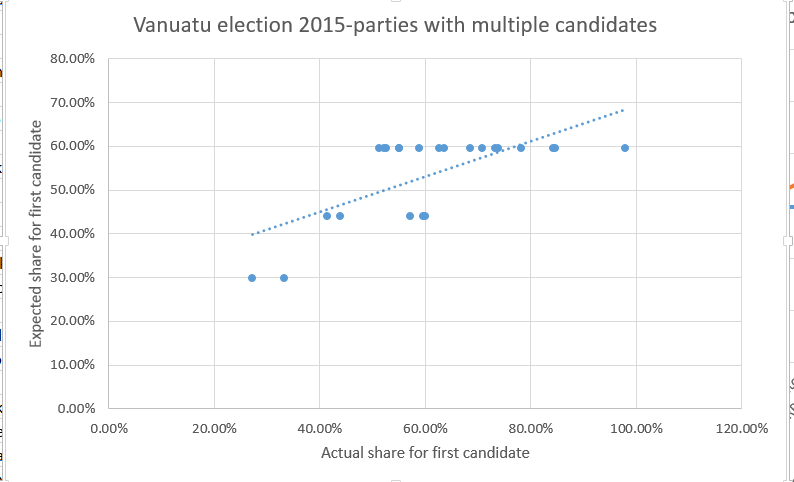
The exact correlation coefficient is 0.687, which seems to me to be quite good given the very odd circumstances in Vanuatu. Bear in mind that this includes losers, which Shugart has advised me are not neccesarily applicable to the equation. If they are removed, the coefficient jumps to 0.76.

One final interesting point; the below graph plots the difference from the expected vote share for the highest polling candidate against the advantage ratio for the party in that district.
It's worth noting that the linear trendline (as well as the correlation coefficient of 0.288) in this graph is relatively meaningless; the graph is dramatically skewed by the single data point in the top right. If removed, the coefficient drops dramatically, to -0.03. However, I don't have anything to compare this against, and I am curious as to whether the high number of independents and single-candidate parties means that parties where the highest polling candidate polls higher than expected do better. I intend to look into this further.

Tuesday, February 23, 2016

Senate Reform-Do compulsory preferences below the line matter?

Those who follow Australian politics closely will be aware that the government is introducing a bill to change the electoral system for the Australian Senate. At the moment, the Senate is elected using the single transferable vote in six-member statewide districts. Elections are staggered so that states elect twelve senators. The territories elect two senators only.

At the moment, compulsory preferential voting is used for both the Senate and the House. This means that voters are required to number every box on the ballot paper. This is not such an onerous task for the House; however, in the Senate, larger numbers of candidates run. Up until 1983, voters were required to express a preference for every candidate on the Senate ballot paper by numbering every box. This led to a high informal rate, as candidate numbers increased.

Following the election of the Hawke Labor government in 1982, the new government, motivated partially by political concerns about informal voting's impact on immigrant voters (who often voted Labor), introduced a new system. Compulsory preferencing was retained; however, before the election, parties could submit a ranked list of all the candidates on the ballot paper. Voters would put a 1 in the box above the line marked with that party's name in order to adopt that party's ticket as their vote.

A Senate ballot paper (Source:Australian Electoral Commission)
This system had the desired effect; the informal rate dropped significantly. However, it had other, less positive side effects.

It meant that parties could transfer their preferences to whichever parties they liked. For example, in 2004, the Labor Party did a deal with the Family First Party, a conservative Christian group, to swap preferences. Labor expected the deal to result in Family First preferences coming to them; instead, it resulted in Family First, on 1.9% of the primary vote, beating the Greens (on 8.8% of the primary vote) to a seat.

It has also meant that small parties can preference each other ahead of major parties, often regardless of ideology. This has meant that senators have been elected on tiny shares of the primary vote; for example, Senator Ricky Muir of the Motoring Enthusiast Party was elected to a Senate seat in Victoria off 0.5% of the primary vote by gathering preferences from a wide variety of parties. Kevin Bonham provides a more complete discussion of the issues.

In recent days, the government has introduced legislation to change the Senate electoral system. The proposed changes would introduce optional preferences above the line. Voters will only have to number one box above the line (although the ballot paper will instruct voters to number six boxes above the line). This vote will go to the candidates of that party's ballot group, and, if no further preferences are expressed, the ballot paper will exhaust (be removed from the count).

However, rather curiously, this provision will only apply above the line. People who wish to vote below the line will still have to number every box, though an extra two errors will apparently be permitted. This goes against the recommendations of the Joint Standing Committee on Electoral Matters.

Exactly who insisted on this is unclear. The legislation is being supported by the Liberal/National Coalition and the Greens, and both blame each other for the proposition. The motivation behind the decision seems to be fear that with optional preferencing, voters will change the orders of party tickets.

However, in my view, this is a baseless concern. Optional below-the-line preferencing, even if above-the-line voting is totally removed, has little impact on the specific people elected.

In New South Wales, the same electoral system as recommended by the committee is used. Voters can vote for one group above the line, which counts as preferences for that group only. They can also number fifteen or more boxes below the line. At the last state election, 1.62% of voters who voted for groups with a box above the line voted below the line. At no point in the history of this particular system have these below-the-line preferences changed the order of election.

You may ask whether the difficulty of numbering fifteen boxes against numbering one means that voters will automatically opt for the easy option. However, this does not appear to be the reason. Before the introduction of group tickets in 1988, New South Wales required voters to number fifteen candidates or more; there was no option for above the line voting. While parties put the candidates in order, it would have been no harder for people to vote against the party ticket.

So, what happened? Well, according to Antony Green's paper on these elections, at each election about 98% of voters voted for the number 1 candidate in each ballot group, and about 98% of those votes transferred to the second candidate.  In South Australia, a similar system was used. I am unsure whether voters were required to number a certain number of candidates. Once again, 98% of voters voted for the first candidate.

The issue appears to be that Australian federal elections do not provide an opportunity for individual candidates to campaign for their own support, and Senate candidates of major parties are not scrutinised. For example, Joe Bullock, a right-wing Western Australian Labor senator, was forced to run for election again following the invalidation of the previous result. Bullock's conservative views received more attention during the by-election, and, as a result, incumbent left-wing Senator Louise Pratt outpolled him on below-the-line votes.

In my view, it is foolish of the government to keep compulsory preferences below the line. If vote exhaustion is okay above the line, it is surely okay below. The political advantages of restricting below-the-line voting are irrelevant, and it would take a number of other reforms (decoupling House and Senate elections, abolition of above-the-line voting, rotating ballot positions, banning how-to-vote cards). However, for the same reason, it does not deserve so much attention; party ordering would likely remain the way Senators were chosen regardless of whether preferences were compulsory or optional.

Note-The government has abandoned the requirement to number all the boxes below the line. Voters are only required to number six boxes, though the ballot paper will state that twelve are required.